Activity analysis
Understand the work being done across your organization to ensure you’re investing your resources in the right way
Trusted by global enterprises









Investing your resources the right way
Are your people spending the right amount of time on the right activities and tasks?
Understanding whether you’re investing your resources in the right way isn’t always straightforward. Exploring the connection between your people and the work being done across the organization requires a considerable effort. This is especially true in large organizations with data scattered across multiple systems or spreadsheets and information being measured in different ways by HR and Finance teams.
So, how do you map the work being done, who has responsibility, and assess cost, so you can evaluate your current state, identify gaps and model your future organization with confidence? Conducting a work activity analysis is essential to ensure proper resource allocation and efficiency.
Want to know more?
How Orgvue helps
Orgvue is a SaaS platform that links people data to workforce activity analysis, so you can see the cost and effort of each activity and who’s doing it. It’s purpose-built to enable you to analyze your organizational structure and redesign when needed.
Understand how your business is doing in terms of:
- Fragmentation: are too many people focused on the same activity?
- Functional alignment: Is any team doing something they shouldn’t be doing?
- Overwork: do smaller teams work more hours than larger teams?
- Focus: who in the organization spends the most time on operational work?
- Role clarity: are the different roles and responsibilities clear to everyone?
- Time sink: do some activities drive more overtime than people say they do?
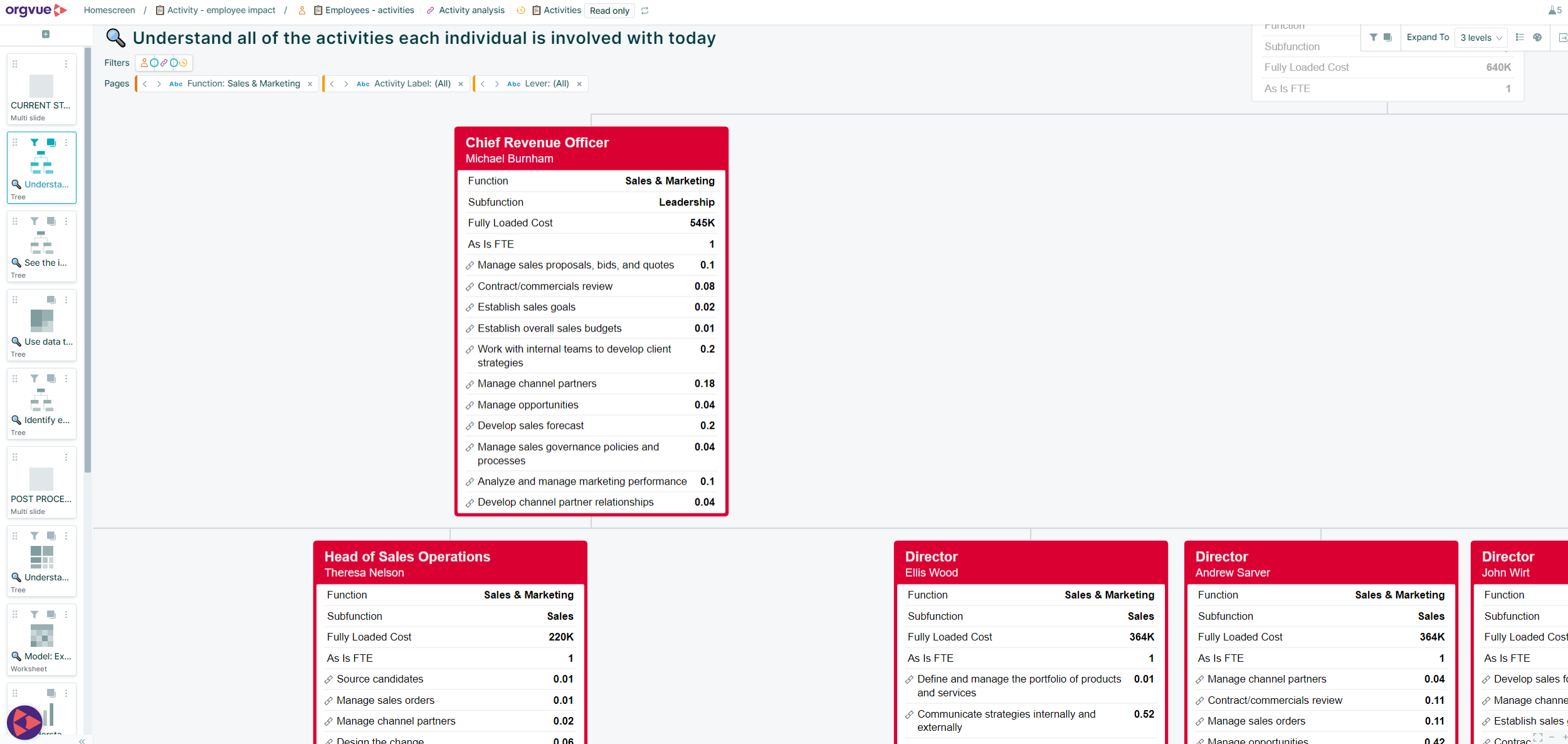
Orgvue shows the individual, their job title and the activities they spend their time on

Orgvue displays details for each activities, including where they’re performed in the business, their nature (strategic, operational and transactional) and their cost
How Orgvue helps you analyze activities
Orgvue helps you see what activities are being done, by whom and where there might be gaps, so you can redesign your activity organization.

Analyze
Analyze how effectively activities are being done
- Merge your HR data with your activity data in Orgvue
- Build an activity taxonomy, so you know exactly what work is being done and by whom
- Understand where there might be gaps and spot areas that need your attention

Design
Model your organization in a safe environment
- Model activities and tasks using Orgvue’s drag-and-drop functionality
- Instantly see the financial impact of your decisions
- Choose the model that works best for your organization

Plan
Use best-in-class methodologies to make your changes
- Use the designs you created to make data-driven decisions
- Plan how you’ll make the move to your future organization
- Put your strategy into practice

Monitor
Track and monitor progress against your plan
- Regularly assess your progress and course-correct initiatives as circumstances change
- Engage stakeholders across the business by exporting and sharing visuals straight to Microsoft PowerPoint
Take advantage of Orgvue’s expertise and best practice
How Orgvue can help you get the right people doing the right work.
Understand your current state
Import data from different sources, such as your finance or HR system, and merge it with activity analytics in Orgvue to understand the work and activities people are doing. From there, build an activity taxonomy that reflects your organization’s service delivery model. You can also use Orgvue’s activity analysis survey to gather information on how people spend their time and add it directly into the platform.
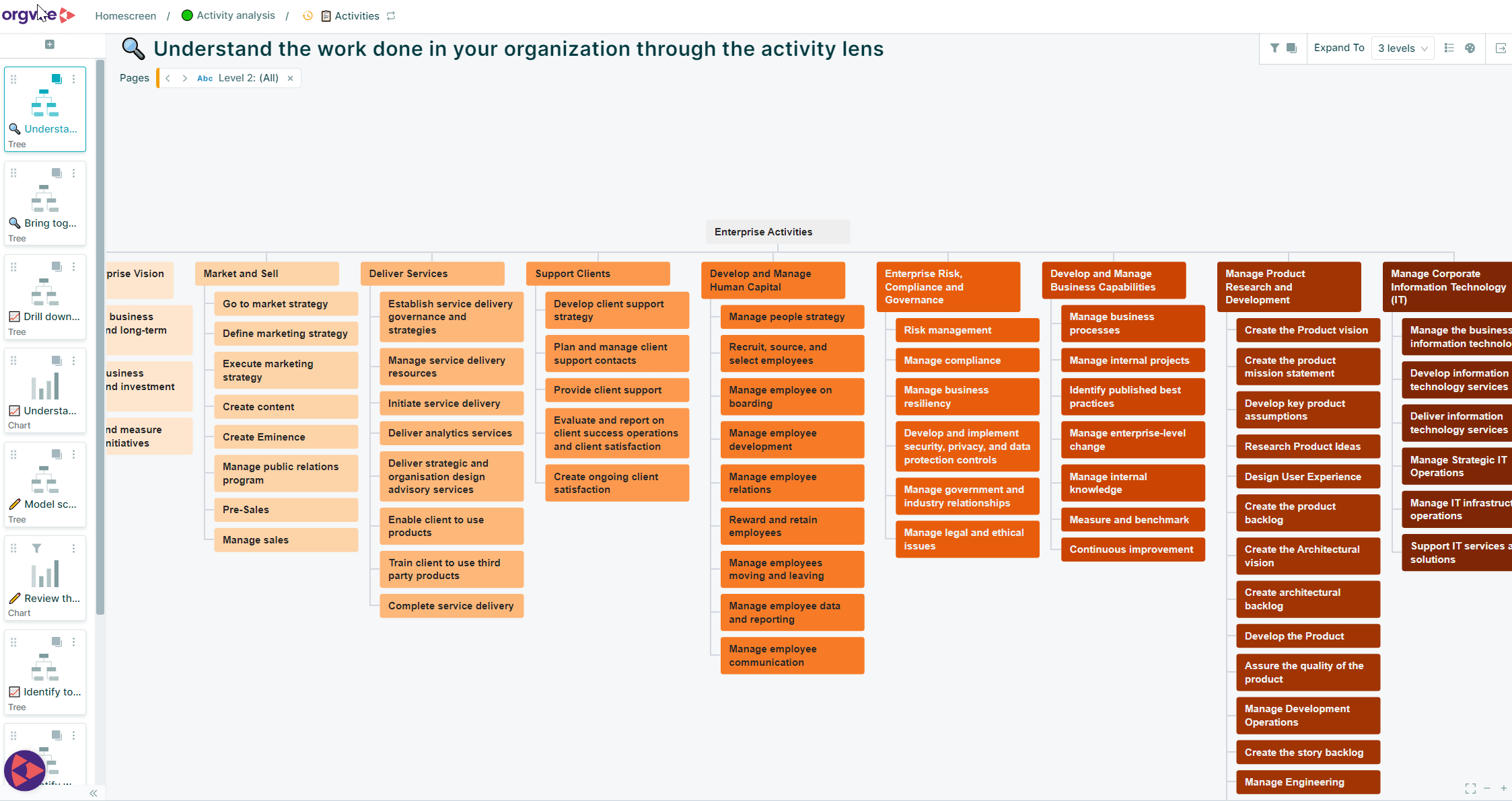
Activity taxonomy in Orgvue, showing what work is being done across the business
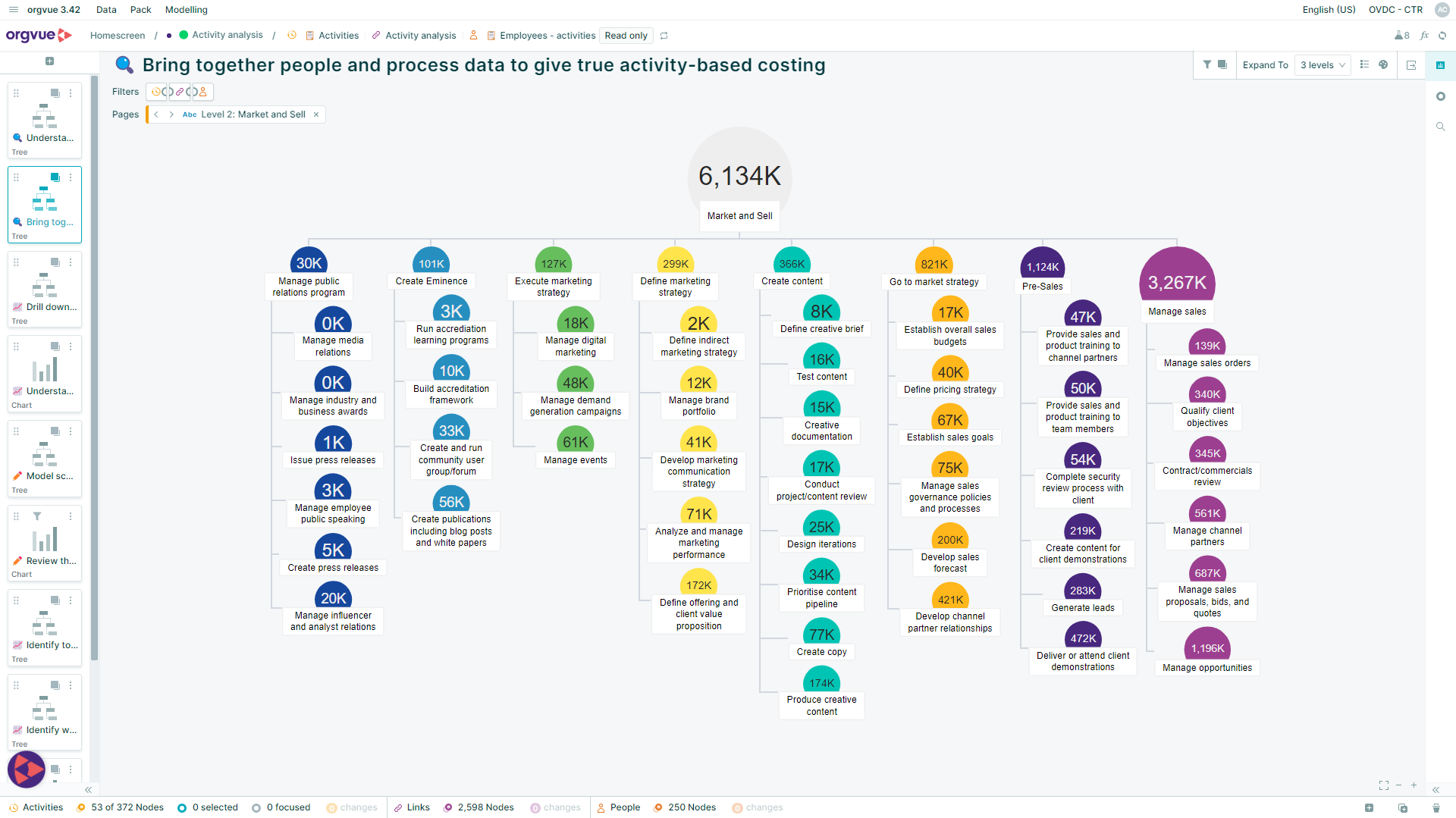
Visualizing the cost of activities: are you over or under-investing in some areas?
Visualize the cost of activities
By combining HR, finance, and work activity analysis data, you can use task analysis to calculate the true cost and effort associated with various tasks. Instead of just looking at people and positions, look at activities and tasks, and analyze how effectively these are being done.
Answer questions such as:
- What is the cost and full-time-equivalent of each activity?
- Should we be spending more time on certain activities?
- What job roles are involved in different tasks?
- Are senior people performing operational tasks?
- Are activities fragmented and can they be consolidated?
Assess if people are doing the ‘right’ work, aligned to their job role
Having understood who performs what work, use Orgvue’s work activity analytics to analyze if people are doing the ‘right’ work. Assess whether people are doing what they’re responsible for, comparing actuals with targets for each role, alongside how consistently work is allocated across similar roles. Use these insights to prioritize opportunities for workforce, organization and process redesign.
You can use Orgvue’s built-in role target setting feature to accelerate role design if data is unavailable from other sources.
Answer questions such as:
- Are people doing the right work?
- Are there opportunities to standardize and clarify role design?
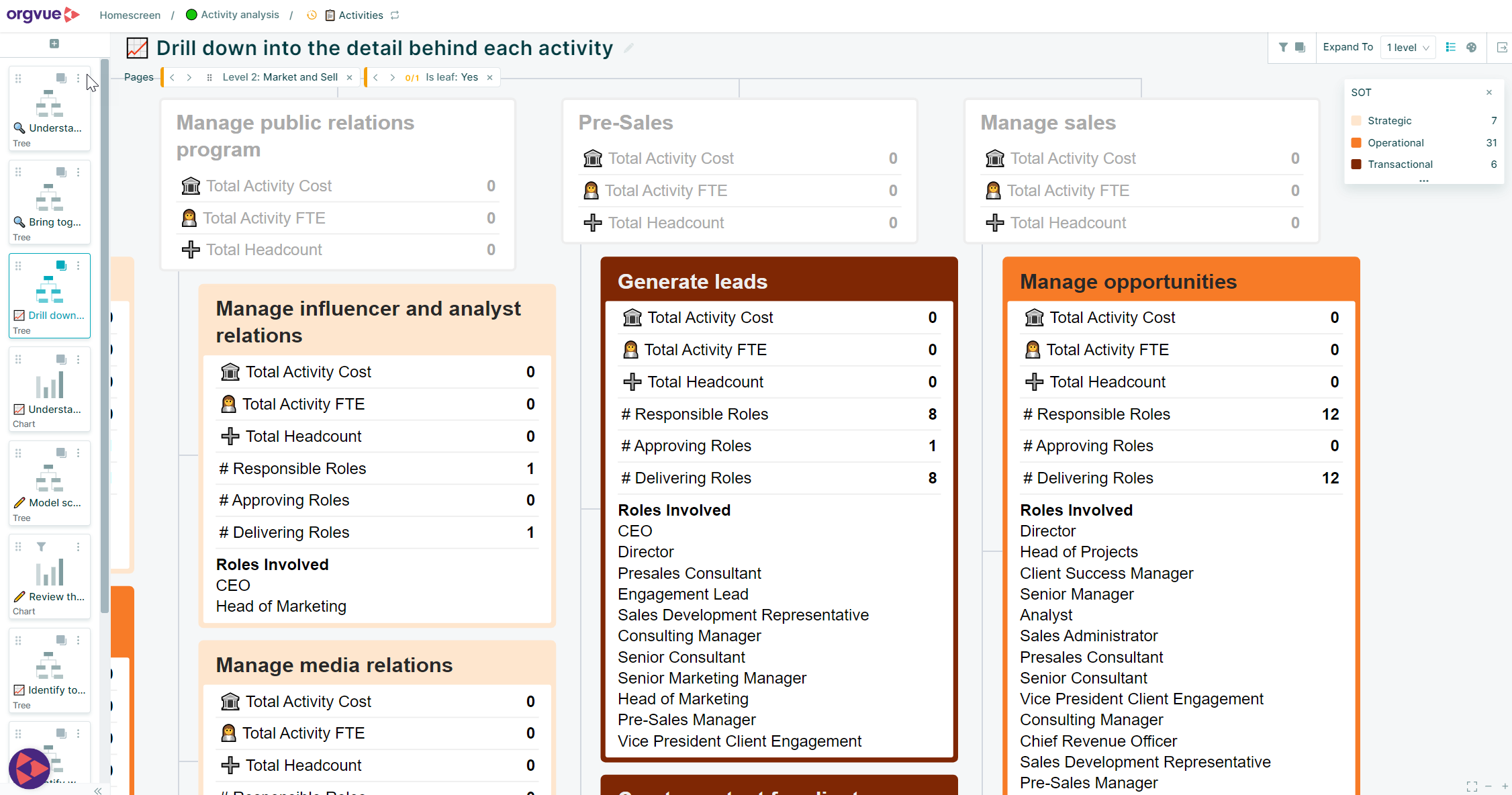
Viewing activities at a granular level: how effectively are these being done? How much is it costing and who is involved?
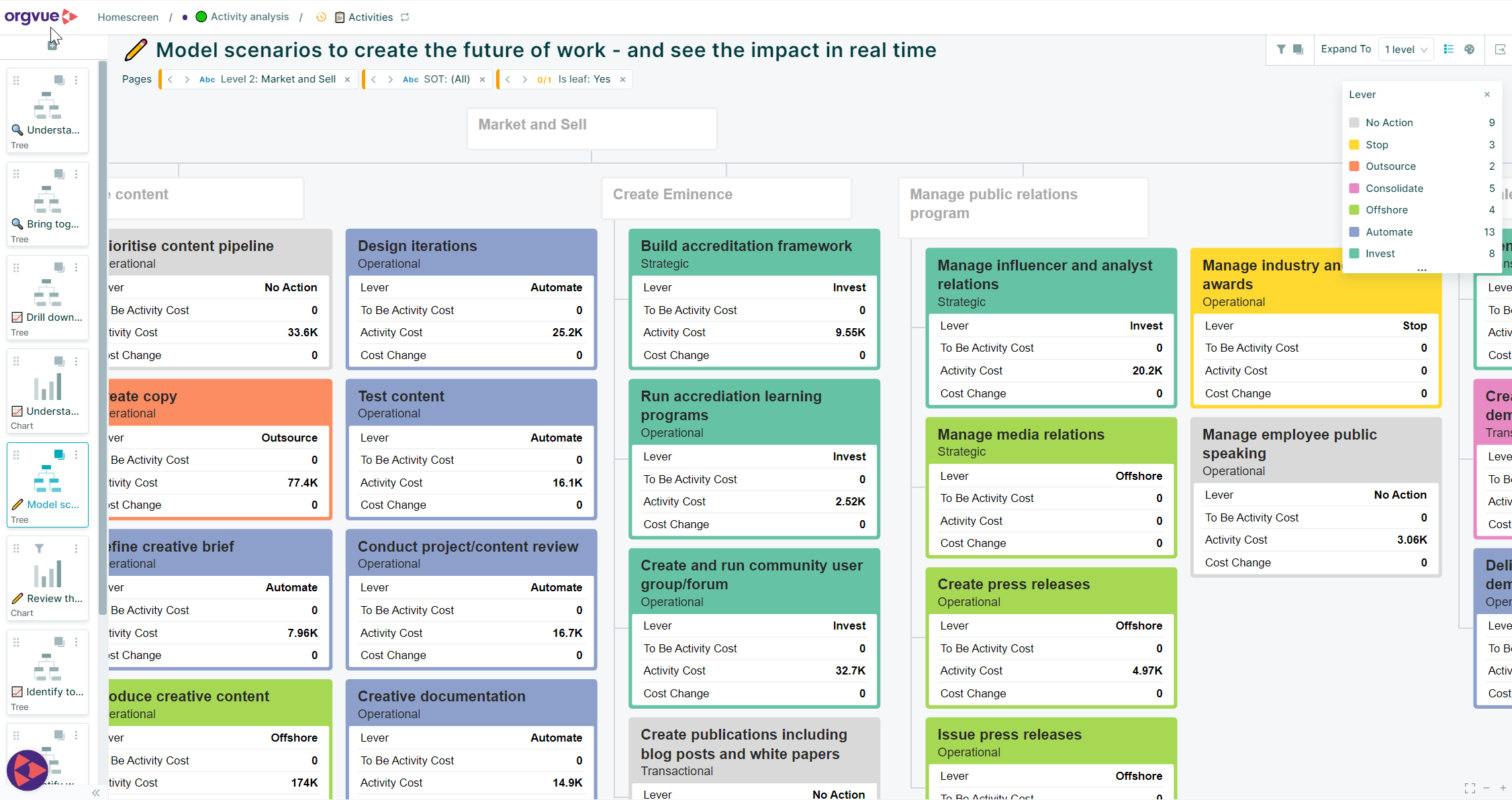
Modeling in Orgvue: making changes to activities using drag and drop, and instantly see the financial impact of those changes
Model scenarios and instantly see the impact on your organization
Using Orgvue’s drag-and-drop functionality, model changes to your organization in a safe environment, reverting back whenever needed. Model the impact of actions such as automating, stopping, offshoring or investing in specific activities. See the impact of your scenarios on the work (what is the new cost of a process?) and people (who will have excess capacity after automating a particular process?) to inform your business case and action plans.
Answer questions such as:
- How will my costs be impacted if I outsource the marketing team?
- What if we automate a process?
- What if I consolidate a task?
Henshaw Assistant

Ask, and your data answers
Henshaw Assistant brings your data to life, giving you instant clarity on your workforce.
Ask questions like:
- Which activities are spread across more than 2 departments?
- Which departments have the highest levels of overwork?
- Which activities have the highest cost?
Customer story
Activity analysis to develop a scalable store model for role design
166
Employees surveyed
166 employees were surveyed from 26 stores.
66%
Identified source of cost
Found that 66% of total cost is spent on admin.
50%
Identified risk
That’s 50% more hours and cost than planned target.

Orgvue was the key to uncover previously unknown truths about how time was spent in store and provided us with actionable insights to optimize the work
VP, Organizational Design
Business goal
- Develop a new global, scalable structure for over 500 stores worldwide
- Allocate time for store roles and assess the relationship each role has with activities
- Optimize work: understand whether employees are using their time effectively
Solution
- Surveyed 166 employees from 26 retail stores, looking at subsets of activities
- Aggregated global employee data to determine time allocation and accountability of roles
- Provided executives with data to confidently redesign roles and their internal labor model, and course-correct in the future
Ready to see Orgvue in action?
In a personalized demo session, discover how Orgvue can help you:
- Understand workforce impacts before restructuring
- Compare multiple operating model scenarios
- Find critical skill gaps across the organization
- Align workforce plans to business strategy
- Accelerate AI workforce transformation
Trusted by global enterprises
“Orgvue’s automated role-clustering capability will save a huge amount of time in surfacing opportunities for organizational redesign, workforce planning, and cost reduction. What we’ve seen so far is truly game changing for design work.”
Stacy Anderson, Salesforce
Get your personalized demo
30-minute discovery call
Demo tailored to you
See our privacy notice. You can unsubscribe from marketing at any time by writing to us at [email protected].
Not ready for a demo? Explore more…




FAQ: Activity analysis
Activity analysis is the process of understanding what work is being done across an organization, who is doing it, how much time it takes, and how much it costs. It helps organizations identify inefficiencies, clarify responsibilities, improve resource allocation, and make better workforce and organizational design decisions.
Activity analysis provides visibility into how time, effort, and resources are spent across the business. By understanding the relationship between people, roles, and work activities, organizations can identify inefficiencies, reduce costs, improve productivity, and align resources with strategic priorities.
Workforce analytics focuses on workforce metrics such as headcount, turnover, spans and layers, and workforce costs. Activity analysis goes deeper by examining the work itself, including tasks, activities, effort, time allocation, and resource consumption. Together, they provide a complete picture of organizational effectiveness.
Activity analysis helps organizations understand how work is performed before making workforce decisions. This enables leaders to identify opportunities for automation, process improvement, role redesign, and workforce optimization while minimizing risk during transformation initiatives.
By identifying duplicated work, fragmented activities, inefficient processes, excessive management overhead, and misaligned resource allocation, activity analysis helps organizations target cost reduction opportunities while maintaining business performance.
Organizations typically combine HR data, organizational structure data, workforce cost information, and activity or survey data. Bringing these sources together enables leaders to understand who performs specific activities, how much effort is required, and the associated costs.
An activity taxonomy is a structured framework that categorizes the work performed across an organization. It creates a common language for understanding activities, comparing teams, identifying overlaps, and analyzing resource allocation consistently across the business.
Activity analysis helps compare actual work performed against role expectations, responsibilities, and business priorities. Organizations can identify situations where highly skilled employees spend significant time on operational or administrative work that could be reassigned, automated, or streamlined.
Understanding work at an activity level helps leaders make more informed organizational design decisions. Activity analysis reveals how work flows across teams, where responsibilities overlap, and which structural changes could improve efficiency and accountability.
Activity analysis helps organizations understand current workforce demand and predict future needs. By connecting activities, skills, roles, workforce costs, and capacity, leaders can create more accurate workforce plans and identify future talent or resource gaps.
Activity analysis helps identify tasks and activities that could be automated, augmented, or redesigned using AI. Rather than focusing solely on job titles, organizations can assess specific work activities and understand how technology will affect workforce requirements, costs, and capacity.
Activity-based workforce planning links workforce decisions directly to the work being performed. Benefits include:
More accurate workforce forecasts
Better resource allocation
Improved productivity
Stronger business cases for transformation
Greater alignment between workforce investments and business objectives
Yes. Activity analysis can reveal where teams are spending excessive time, experiencing workload imbalances, working beyond planned capacity, or lacking sufficient resources. This helps organizations address burnout risks and improve operational efficiency.
Scenario modeling allows organizations to test future changes before implementation. Leaders can explore the impact of outsourcing, automation, process redesign, role consolidation, or increased investment and immediately assess the impact on workforce costs, capacity, and organizational performance.
Orgvue connects workforce, organizational, financial, and activity data in a single platform. Organizations can build activity taxonomies, understand the cost and effort associated with work, identify inefficiencies, model future scenarios, and make data-driven decisions about workforce transformation, organizational design, and resource optimization.