Organization analysis
Bring your data from different sources into Orgvue, align it and create a single source of truth, so you can see how your business is performing.
Trusted by global enterprises










What is Organization Analysis?
Organization analysis is about examining, evaluating and understanding an organization’s structure, processes, functions, culture, and performance. It involves a comprehensive study to understand how the organization operates, how different parts interact, where there are gaps and how effectively it achieves its goals.
Whether it’s for a merger and acquisition, cost optimization exercise or workforce transformation, understanding your organization’s current state will be pivotal in making fast, informed decisions.
Orgvue was purposely built to visualize data in an incredibly powerful way. It empowers you to seamlessly bring together multiple datasets and build a baseline representation of your workforce, giving you the ability to draw robust and valuable insights, and enabling you to make informed decisions with confidence.
Want to know more?
Analyzing your organization and managing data is not always easy
Analyzing a large organization based on data presents its fair share of challenges. In an era defined by constant change and transformation, the role of data in understanding an organization’s complexities cannot be overlooked. Yet, most organizations still struggle to bring data together from multiple platforms (for example HR systems, finance systems and spreadsheets) and make sense of it.
How Orgvue helps you visualize your organization and draw insights
Orgvue enables advanced organizational data management and structure analysis, allowing you to see your workforce like never before, design future changes, and tell your story using powerful visuals.
Benefits of Organizational Analysis
Organization analysis is about carefully examining an organization’s structure, processes, functions, and culture. By doing so, it sheds light on the organization’s strengths and weaknesses, and enables leaders to make decisions that lead to better alignment with strategic goals, optimized processes, and a more effective and adaptable organization.
By analyzing and understand your organization, you can:
- Enable data-driven decision-making
- Identify gaps and risks in your organization
- Understand and leverage your strengths
- Increase your overall organizational effectiveness
- Continuously improve your performance and encourage growth
Henshaw Assistant

Ask, and your data answers
Henshaw Assistant brings your data to life, giving you instant clarity on your workforce.
Ask questions like:
- Show me where higher grade employees are reporting to lower grade managers
- Which department has the highest fully loaded cost?
Take advantage of Orgvue’s expertise and best practice
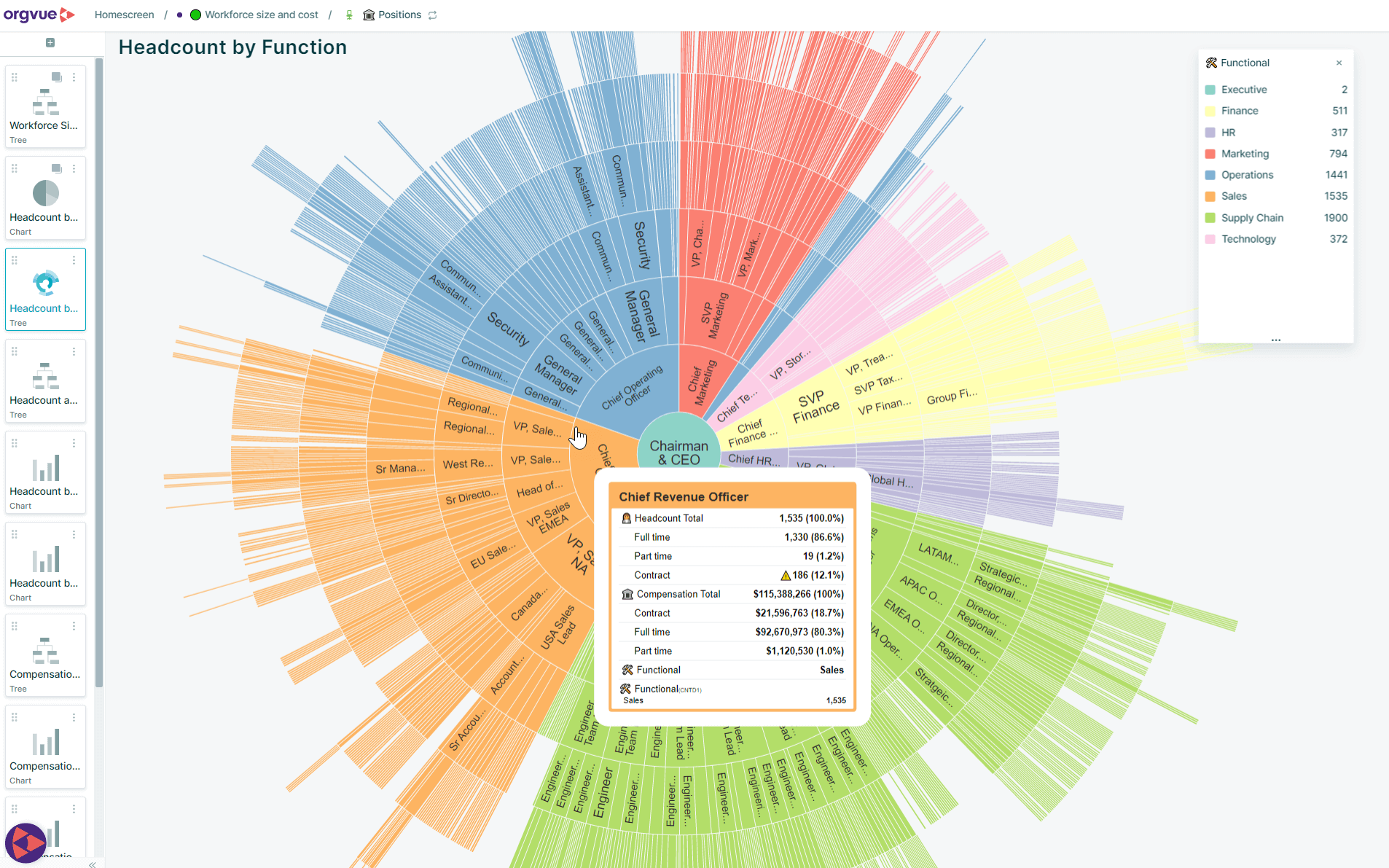
Showing an organization chart as a ‘sunburst’ visualization in Orgvue, color-coded by department
Integrate and align your data into a single source of truth
Orgvue allows you to bring your workforce data together from many different sources into a single source of truth. Realign your numbers, hierarchies and labels from different systems using Orgvue’s drag-and-drop functionality.
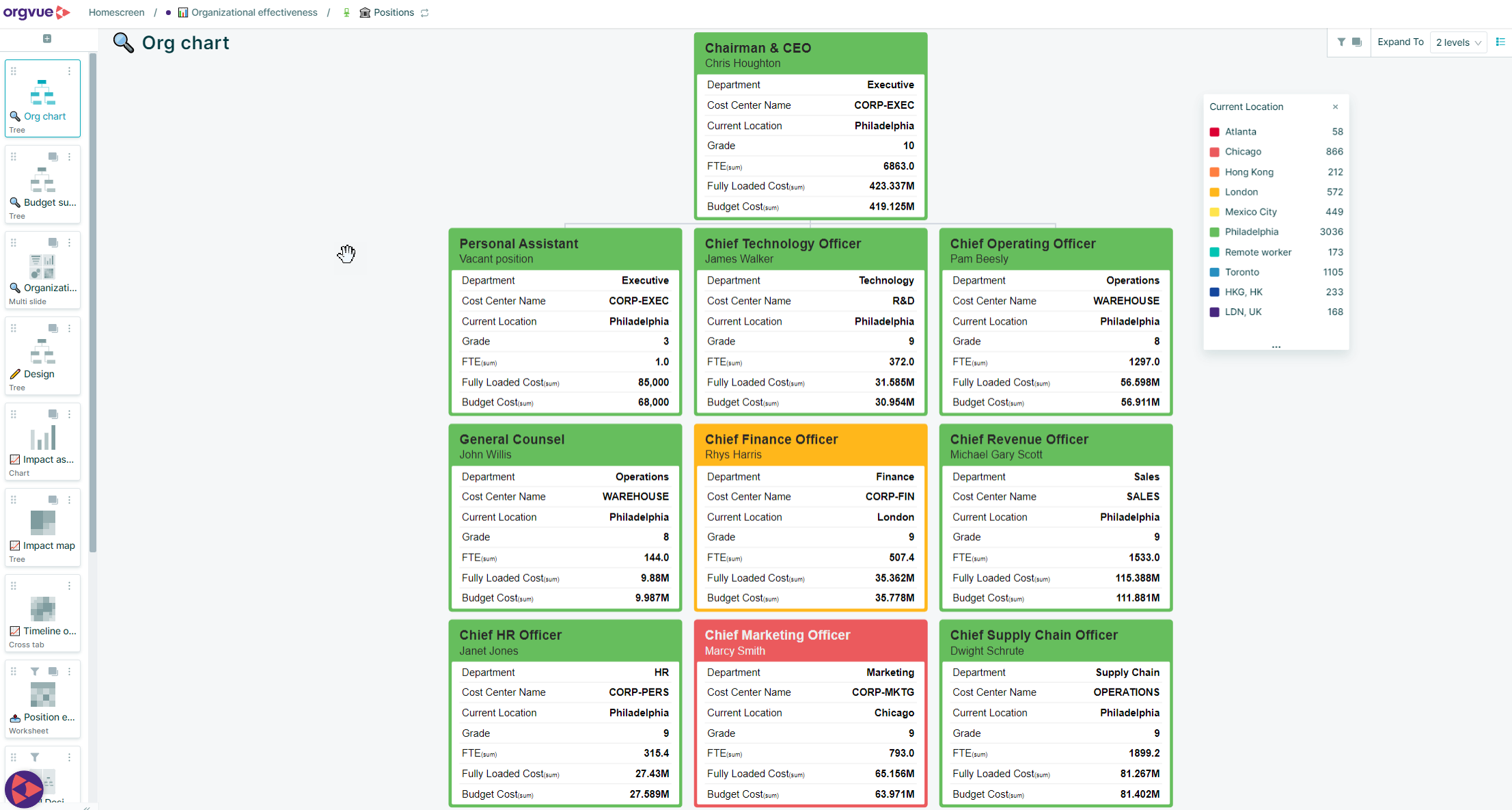
Example in Orgvue showing an organization chart of positions data, people data and financial data, color-coded by country
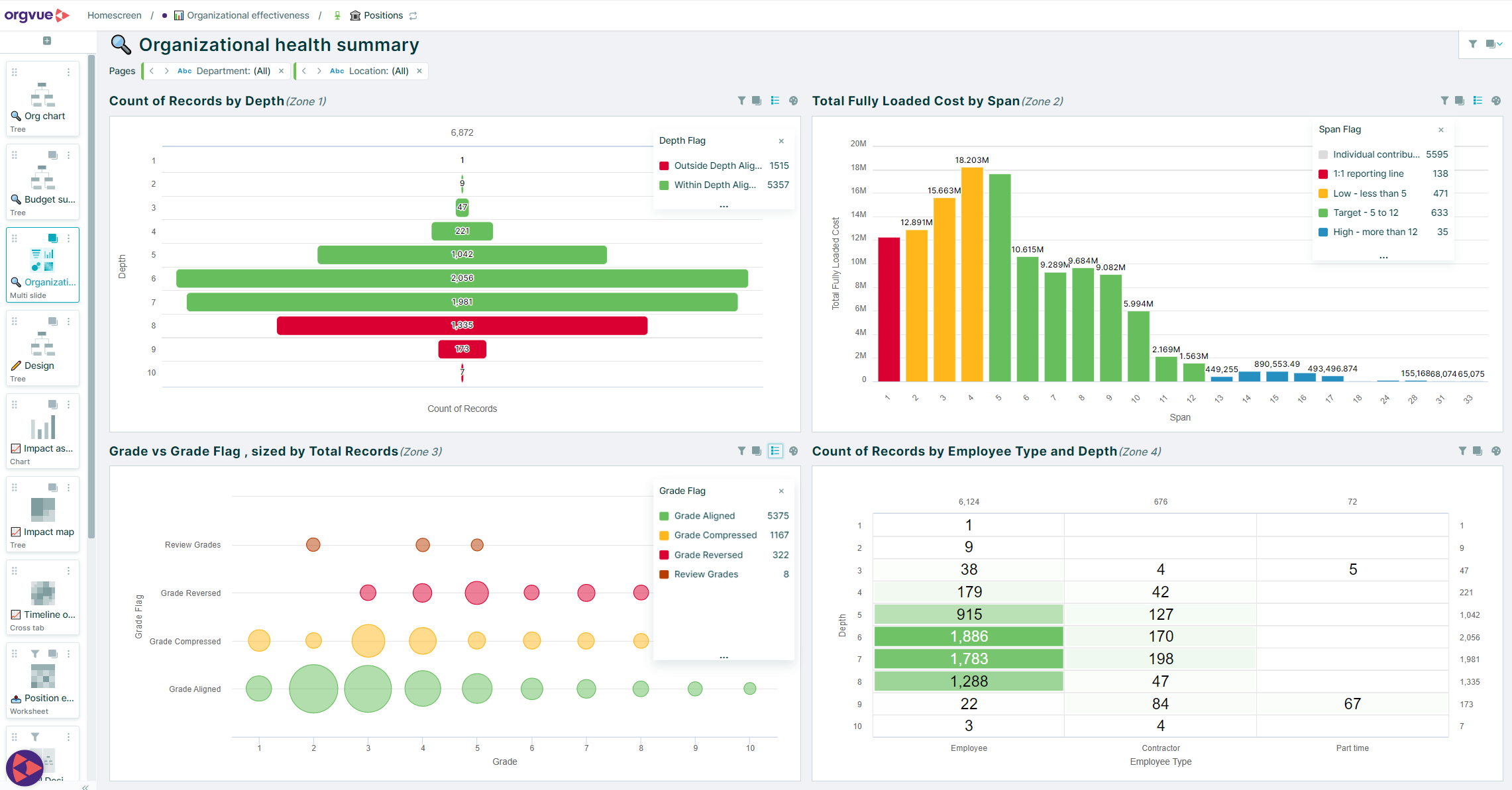
Multiple visuals showing overall organizational structure to identify potential gaps
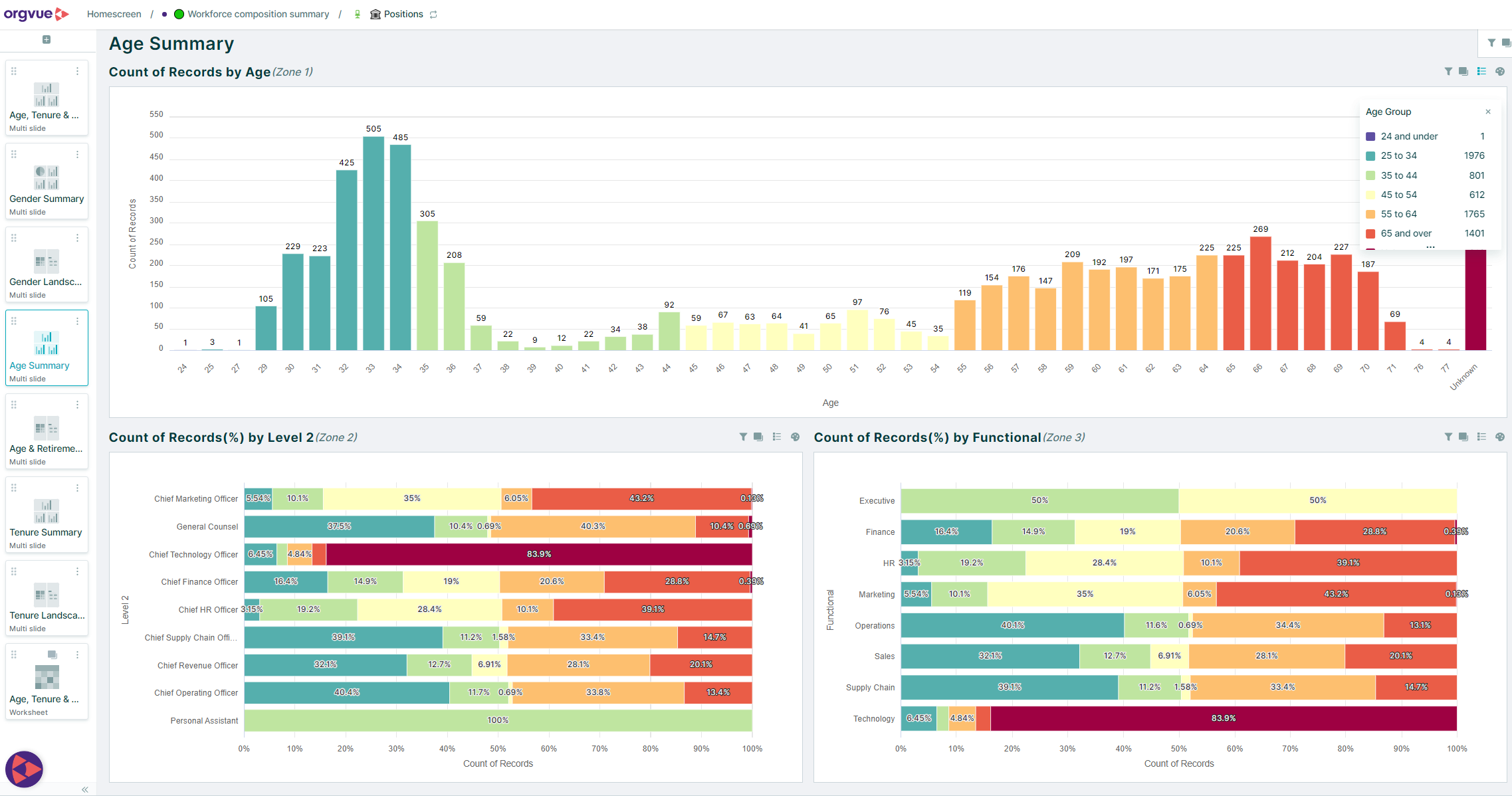
Multiple visuals showing the workforce composition to identify potential gaps
Analyze your current state
Pick from a set of visuals that will enable you to explore specific areas of your business, as a whole and at a granular level. With each visual, you can hover over the charts, look closely at numbers, zoom in and out, and explore the data.
Answer questions such as:
- How many layers do I have in my organization?
- Are my teams the size I want them to be?
- Where are higher-grade employees reporting to lower grades?
- Are there too many contractors at the top of the organization?
- How many employees do I have on each layer?
- What is the age composition of my workforce? Should I reassess my talent strategy?
- Which department has the highest fully-loaded cost?
Report on talent and ensure you’re in line with your design principles
Look at the composition of your workforce and make sure the overall picture is in line with your design principles, covering gender diversity, ethnic diversity, age and tenure, and answer questions such as:
- What’s the gender split by grade? Do I have an imbalance at the top?
- Is there a major gender imbalance in one of my departments?
- What does the gender split look like overall in my organization?
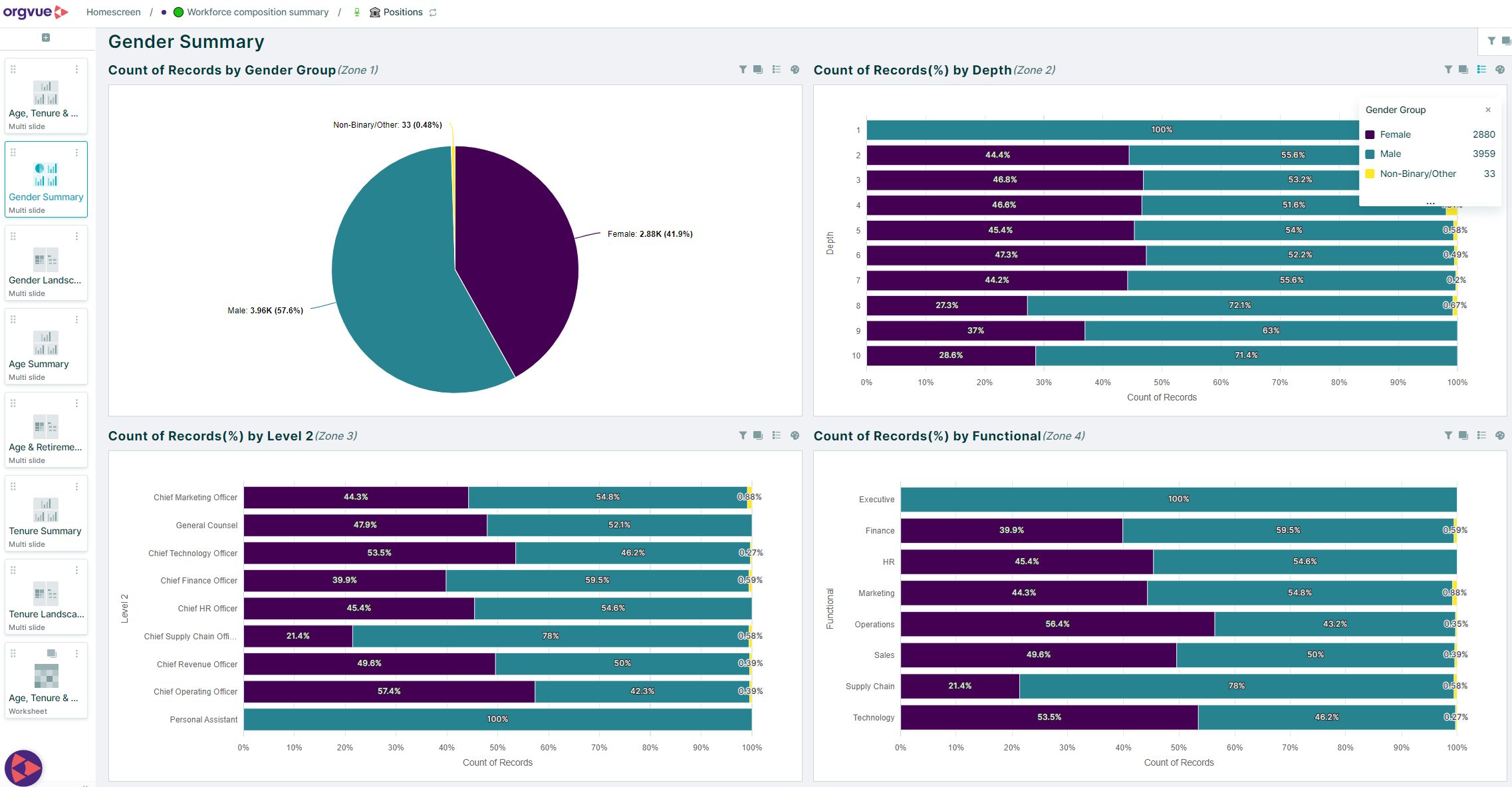
Showing diversity and inclusion data in Orgvue to answer questions using different zones.
Ready to see Orgvue in action?
In a personalized demo session, discover how Orgvue can help you:
- Understand workforce impacts before restructuring
- Compare multiple operating model scenarios
- Find critical skill gaps across the organization
- Align workforce plans to business strategy
- Accelerate AI workforce transformation
Trusted by global enterprises
“Orgvue’s automated role-clustering capability will save a huge amount of time in surfacing opportunities for organizational redesign, workforce planning, and cost reduction. What we’ve seen so far is truly game changing for design work.”
Stacy Anderson, Salesforce
Get your personalized demo
30-minute discovery call
Demo tailored to you
See our privacy notice. You can unsubscribe from marketing at any time by writing to us at [email protected].
Not ready for a demo? Explore more…


FAQ: Organization analysis
Organization analysis is the process of examining an organization’s structure, workforce, processes, costs, and performance to understand how effectively it operates. It helps leaders identify opportunities, risks, inefficiencies, and areas for improvement so they can make informed decisions about workforce planning, organizational design, and business transformation.
Organization analysis gives leaders a clear understanding of how their business operates today. By identifying strengths, weaknesses, risks, and structural challenges, organizations can improve decision-making, optimize costs, strengthen workforce planning, and better align resources to strategic objectives.
Organization analysis typically combines workforce, financial, operational, position, and organizational structure data. By bringing these datasets together, organizations can better understand workforce composition, reporting structures, labor costs, spans and layers, and overall organizational effectiveness.
Organization analysis provides the baseline understanding needed for effective organizational design. It helps leaders identify management layers, reporting issues, workforce imbalances, role duplication, and cost drivers before designing a future-state organization.
Spans refer to the number of direct reports managed by a leader, while layers refer to the number of management levels within an organization. Analyzing spans and layers helps organizations identify excessive hierarchy, management inefficiencies, and opportunities to improve organizational effectiveness.
Organization analysis helps uncover workforce risks such as excessive management layers, high labor costs, critical role dependencies, workforce demographic challenges, diversity gaps, succession risks, and structural inefficiencies. Identifying these risks early allows organizations to take proactive action.
Organization analysis helps leaders understand workforce structures, reporting relationships, costs, roles, and skills across multiple organizations. This visibility supports due diligence, workforce integration, operating model design, and post-merger workforce planning.
Yes. Organization analysis enables organizations to assess workforce composition across factors such as gender, ethnicity, tenure, age, grade, and leadership levels. These insights help identify representation gaps and support diversity, equity, and inclusion initiatives.
Organizational effectiveness measures how successfully an organization aligns its people, structure, processes, and resources to achieve business objectives. Organization analysis helps leaders understand the factors influencing effectiveness and identify opportunities to improve performance.
Orgvue brings together workforce, organizational, financial, and operational data into a single source of truth. Leaders can visualize organizational structures, analyze workforce composition, identify risks, measure organizational effectiveness, and create a data-driven foundation for planning and transformation.