Cost reduction solutions
Reduce workforce cost with clarity and AI-driven design
The challenge of sustainable cost reduction in a changing world
Most organizations cut costs when pressure hits. Intentional enterprises use cost reduction to strengthen capability. In a volatile environment, leaders need to move fast with clear visibility of where spend can come down without losing the skills that enable future growth.
Reactive cuts often trigger a disruptive cycle of fire and rehire that raises cost and leaves core issues unresolved. To succeed, you need clarity on cost, capability, and risk, so intentional cost reduction can become a foundation for long term resilience.
The fire-to-hire cycle
Want to know more?
Common cost reduction challenges
Organizations aiming for sustainable cost reduction often face challenges that limit real impact.
- Inefficient workforce data managementData spread across multiple systems makes it hard to see a full picture of costs and capability, and data managed through manual spreadsheets often leads to errors and outdated information.
- Hidden costs of transformation
Severance, voluntary exits, and disengaged teams can outweigh planned savings, turning reductions into an unintentional expense. - Employee resistance and moraleWhen changes lack transparency, employees feel disconnected and undervalued. Change fatigue and resistance build across the workforce.
- Misalignment across HR, Finance, and the business
Without a shared view of data, teams lose time reconciling details instead of aligning on outcomes. - Talent and capability risks
Reducing headcount without understanding critical skills threatens operations and future competitiveness. - Short term pressure vs. long term needs
Leaders must meet immediate targets while protecting capability. Precision is essential to avoid cuts that weaken resilience.
Introducing Orgvue
Whether you are responding to immediate pressure or building long term transformation capability, Orgvue becomes the intelligence layer, that supports both short term decisions and ongoing organizational design, by enabling:
- Total clarityA unified view of data that shows cost drivers, critical roles, and capability gaps
- Informed decisions at speedModel changes and see the financial and operational impact before you commit
- Confidence in complexityUse evidence to protect critical skills, reduce risk, and design for long term value

features and benefits
How it helps
Quickly bring your workforce data together and start analyzing your business
- Consolidate data from HR, Finance, payroll, skills, and performance systems into a single view
- Clean and align this data to create an accurate source of truth you can rely on
- Analyze cost drivers, spans and layers, duplicated work, retirement risk, and other insights that show where action matters most
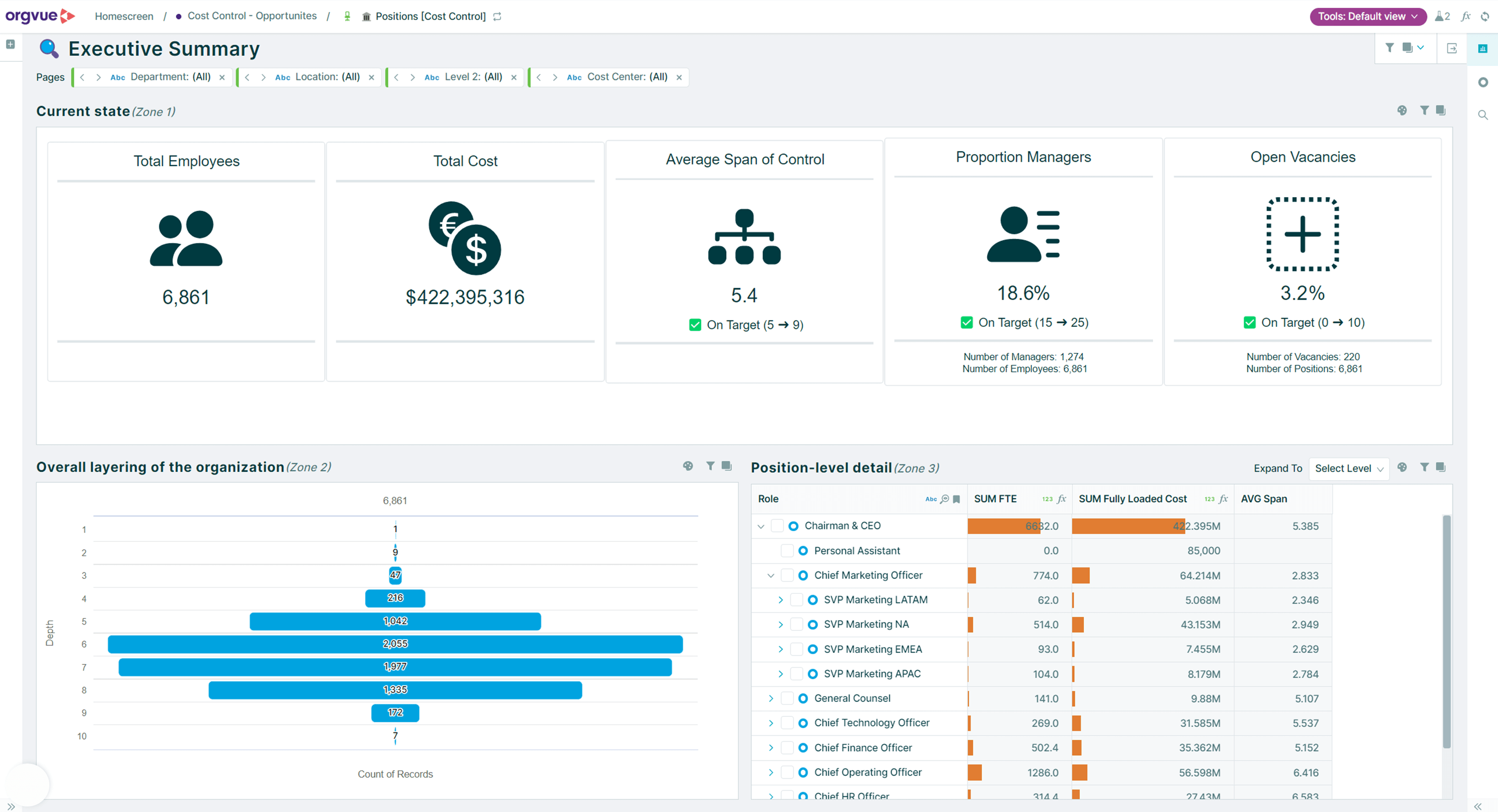
Orgvue dashboard with a current overview of the workforce
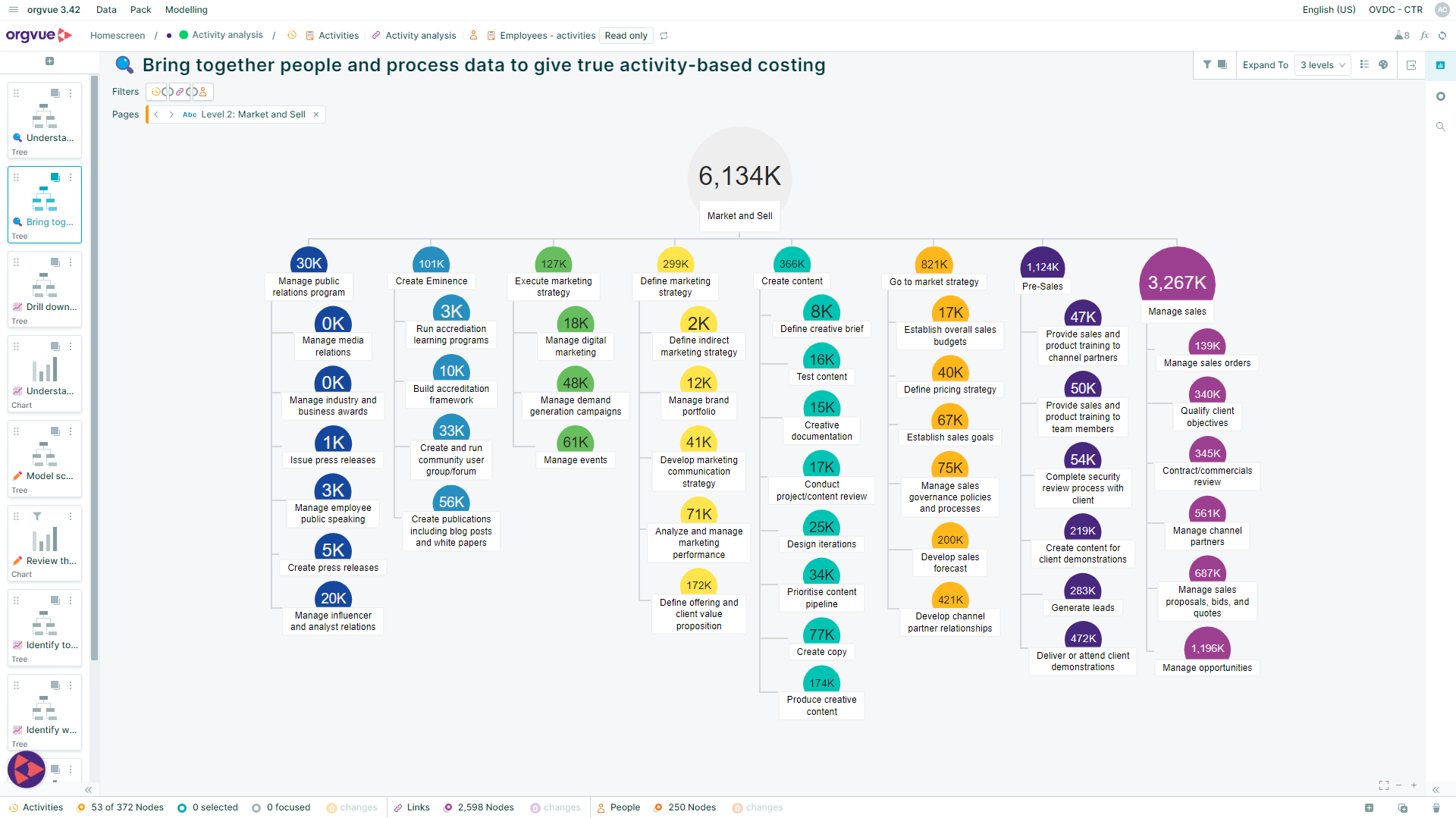
Visualizing activity costs to see where there may be over or under investment
Understand the activities and skills across your business
- Visualize the work being done, who performs it, and the cost behind each activity
- Identify critical skills and where they sit in the organization
- Spot essential talent and potential areas of risk
Model scenarios and design your future workforce
- Add, remove, or adjust positions to explore different workforce options
- See the cost impact of each change and discard scenarios that do not deliver value
- Apply criteria such as skills, performance, tenure, and activities to make data driven decisions
Showing a role being outsourced within a modeled scenario
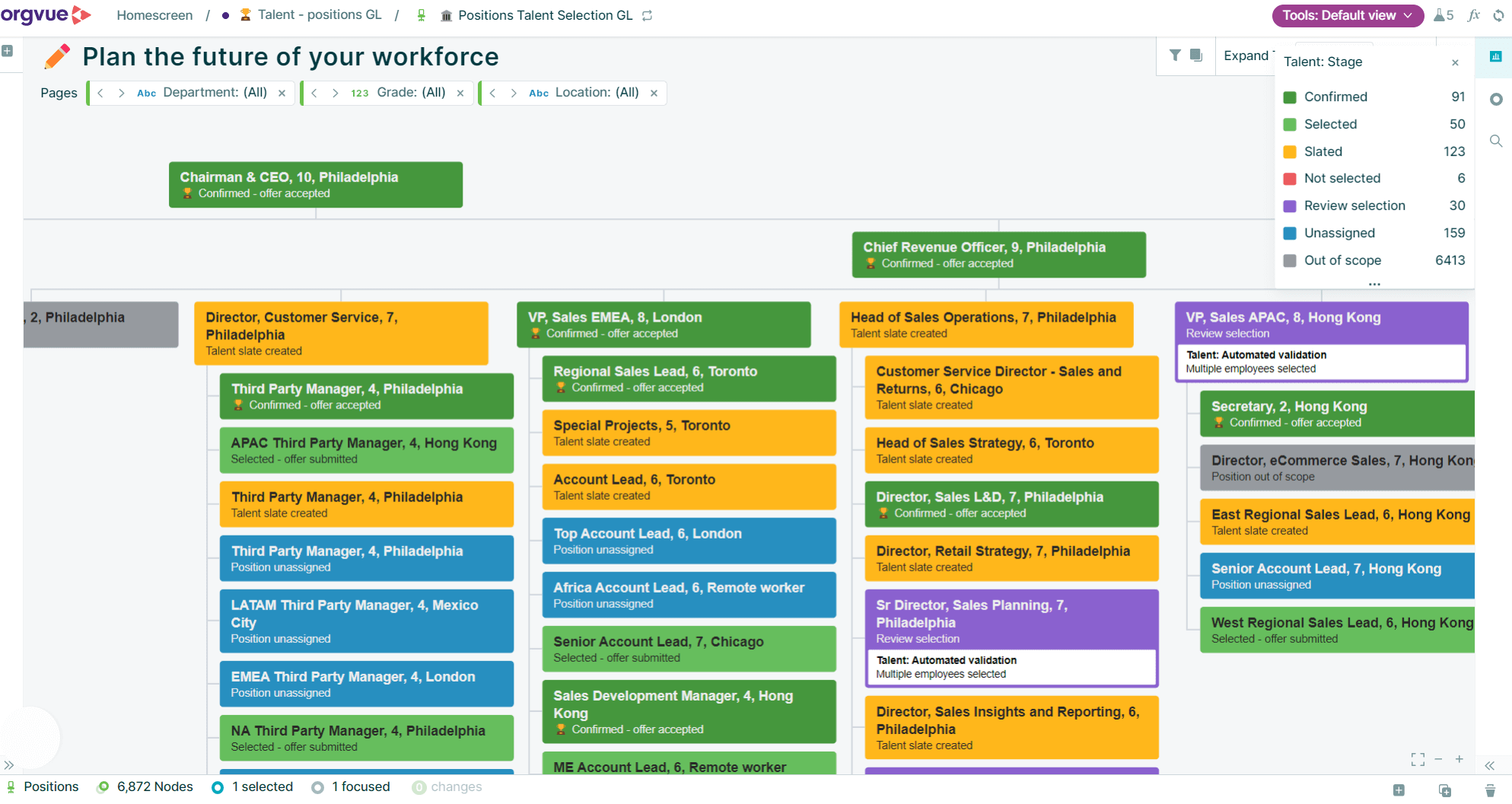
Orgvue view showing talent selection progress on the org chart
Implement your plan and allocate the right talent to your new structure
- Build talent pools by shortlisting people based on role requirements
- Confirm the best candidates for each role once scenarios are agreed
- Manage implementation, redeployment, and any required exits after decisions are made
Monitor progress and maintain long term productivity
- Track progress against your plan and report on value delivered
- Monitor employee movement including joiners, movers, and leavers
- Iterate and re-model quickly as internal or external conditions change
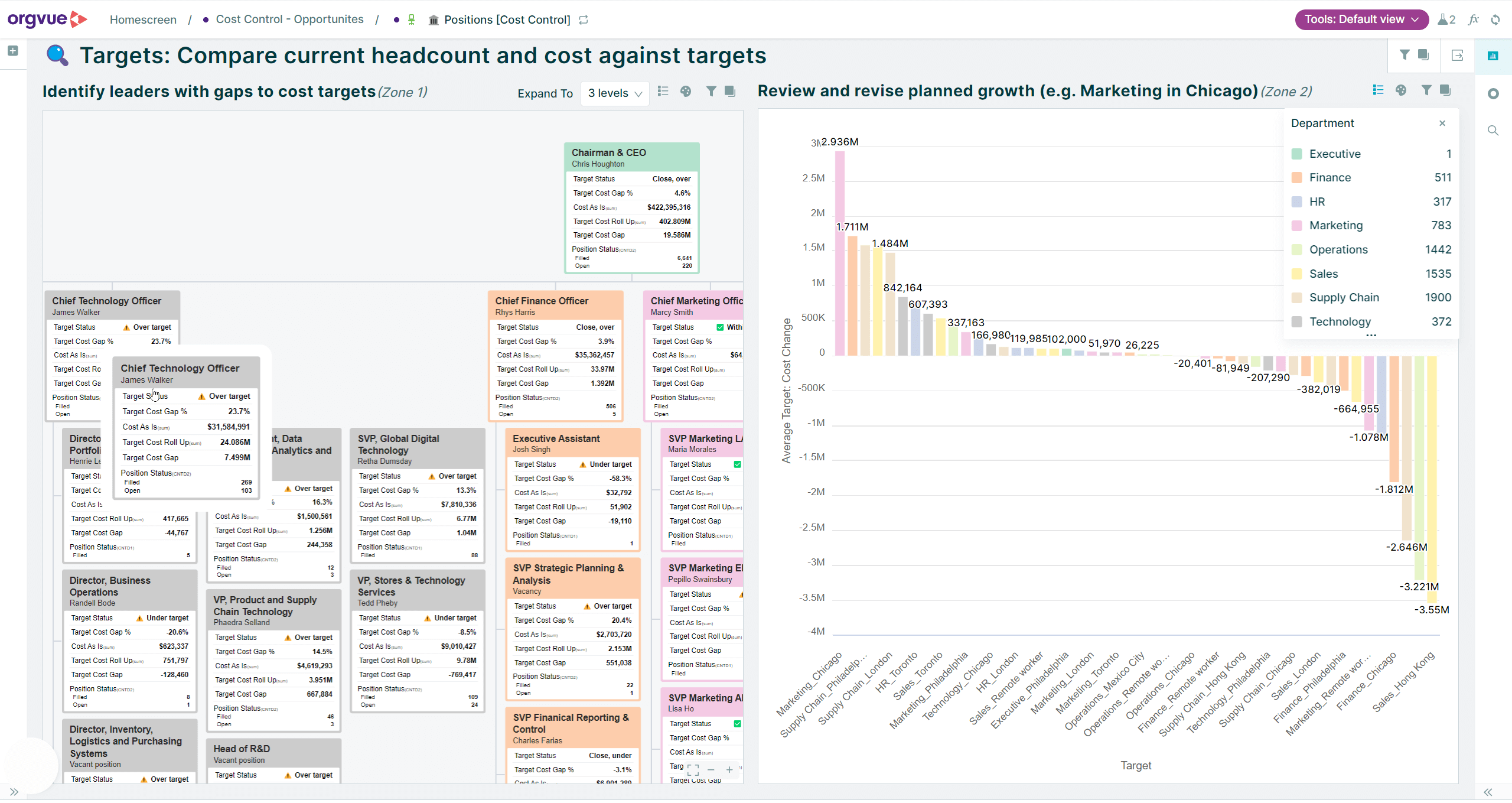
Comparing current headcount and cost against targets
Customer story
Re-designing 250,000 positions as quickly and effectively as possible

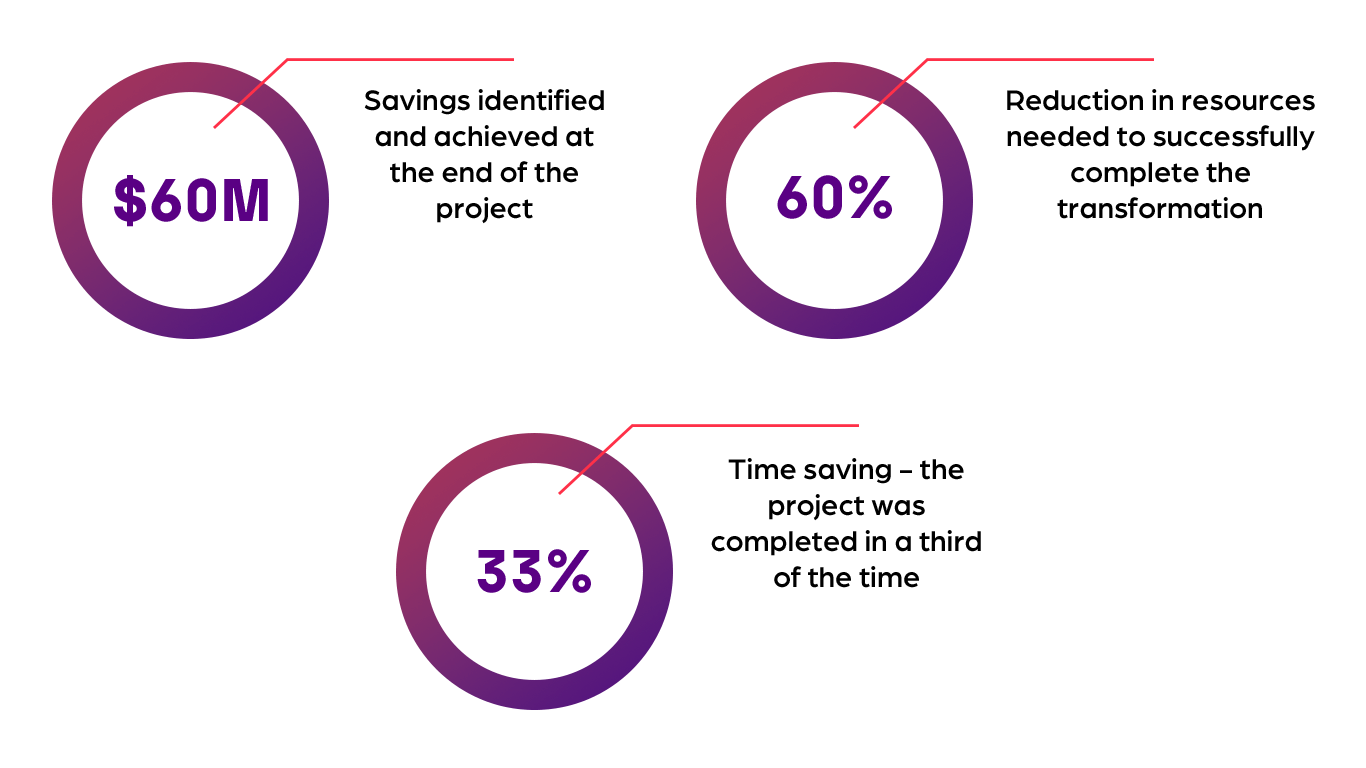
Under normal circumstances we would expect a 20-strong team to take 6 months to do this, but with Orgvue a team of 8 did it in 2.
Chief Transformation Officer, global bank with 250k+ employees
Business goals
- To re-design 250,000 positions in a global bank, into a new structure focussed on customer service experience.
- To automate select roles and activities with a target saving of $60m over 3 years.
Solution
- Using Orgvue, they modeled different design options and visualized scenario impacts.
- They then mapped the ‘to-be’ design against a sub-group of 45,000 employees and tested.
- They built a transformation center of excellence based around Orgvue for workforce modeling.
FAQs
Reactive cuts focus on short term savings and often lead to repeated cycles of fire and rehire. Sustainable cost reduction uses clear visibility of cost, capability, and risk to redesign the organization in a way that protects long term value. Orgvue helps you make decisions that solve today’s pressure without weakening tomorrow’s growth.
Orgvue unifies workforce, financial, and operational data and pairs it with external talent intelligence to show where essential roles, skills, and activities sit. This clarity helps you reduce cost while protecting the capability your business depends on. Leaders can model scenarios to see the impact before committing to any change.
Yes. Orgvue highlights the financial and operational implications of workforce changes, including severance, loss of critical skills, and the impact of disengagement. This helps organizations avoid reductions that save in the short term but create higher costs or operational risk later.
Orgvue lets you consolidate and analyze workforce data in days, not months. This supports leaders facing immediate pressure by giving them the insight needed to act quickly while maintaining accuracy and protecting capability.
Yes. Cost reduction is often the entry point to broader transformation. Orgvue becomes the intelligence layer that supports continuous organizational design, scenario modeling, and long term workforce planning so you can shift from reactive actions to intentional, ongoing capability.
Workforce optimization is a comprehensive strategy aimed at maximizing the efficiency and effectiveness of an organization’s human resources to boost overall performance and achieve company goals. It integrates a wide array of practices and technologies, including talent management, workforce planning, training, performance management and enhanced communication through technology, all underpinned by data analytics.
This approach ensures that the workforce is well-aligned with organizational needs, optimally deployed, and fully utilized, thus reducing labor costs and increasing productivity. At its core, workforce optimization seeks to enhance customer satisfaction by fostering a work environment where employees are engaged, skilled, and motivated, ensuring compliance with labor regulations and enabling the organization to swiftly adapt to market changes. This not only drives innovation and growth but also creates a satisfying and efficient workplace, benefiting both employees and the organization.
In a retail chain example, workforce optimization is demonstrated through the adoption of an advanced scheduling system, leveraging predictive analytics to efficiently align staffing with fluctuating customer foot traffic. This approach is bolstered by investing in employee training for customer service and operational efficiency, including cross-training for flexibility in roles, which enhances both customer satisfaction and employee engagement.
The strategy encompasses performance management with feedback based on data-driven metrics, facilitating continuous improvement and career growth. This integrated approach to workforce optimization not only matches staff capabilities with business needs, increasing operational efficiency and service quality, but also fosters a work environment conducive to employee satisfaction and development, illustrating a comprehensive application of workforce optimization principles.
A Workforce Optimization Manager is instrumental in maximizing the efficiency and effectiveness of an organization’s human resources to achieve business objectives. They are tasked with analyzing, planning, and implementing strategies to boost productivity, enhance employee satisfaction, and minimize operational costs. Their role encompasses overseeing workforce planning and scheduling, using data analytics for demand forecasting and performance assessment, and working closely with HR to align recruitment, training and development with strategic needs.
They also implement performance management systems for continuous feedback and improvement, and play a key role in change management to keep the workforce flexible and responsive to new challenges. Through a comprehensive approach to workforce management, the Workforce Optimization Manager significantly contributes to improved productivity, lower turnover, and heightened employee engagement, thereby supporting the overarching success of the organization.
Manpower optimization is a strategic approach aimed at maximizing the efficiency and effectiveness of an organization’s human resources. It involves aligning the workforce’s size, skills, and productivity with the organization’s goals demands, ensuring that every employee’s potential is fully utilized for optimal performance. This process encompasses a variety of practices, including workforce planning, skill development, performance management, and technological integration, to enhance both employee satisfaction and operational efficiency.
In essence, manpower optimization seeks to ensure that the right number of employees, with the right skills, are in the right places at the right times. It involves analyzing current workforce capabilities, identifying gaps, and forecasting future needs to make informed decisions on hiring, training, and deploying personnel. By doing so, organizations can avoid the pitfalls of under or overstaffing, which can lead to increased operational costs or diminished service quality.
Effective manpower optimization strategies also focus on improving communication and collaboration within teams, streamlining workflows, and adopting technologies that support better management of human resources. Additionally, it emphasizes creating a supportive work environment that encourages professional growth, innovation, and high levels of employee engagement. Ultimately, manpower optimization is about leveraging human capital as efficiently as possible to achieve the organization’s objectives while ensuring the workforce is motivated, satisfied, and productive.
Workforce optimization does not inherently mean layoffs. Rather, it focuses on making the most effective use of an organization’s human resources to improve productivity, efficiency and satisfaction. This strategy might include reallocating or retraining staff, improving processes, or implementing new technologies to enhance performance.
While optimization can sometimes lead to restructuring that affects staffing levels, the primary goal is to align employee skills and numbers with the organization’s current and future needs. In many cases, workforce optimization efforts aim to retain valuable employees by developing their skills and competencies to match evolving business requirements, thus avoiding layoffs and fostering a more engaged and versatile workforce.
More resources










See how Orgvue works
We’re excited to show you how Orgvue can help. Before we do, we’ll just need to schedule a quick call to better understand your needs and tailor a demo specific to you.
Complete the form to get started.
Not ready to book a demo?
Submit an enquiry
See our privacy notice. You can unsubscribe from marketing at any time by writing to us at [email protected].
Trusted by