Annual position planning
Plan workforce size, cost, and structure across the business cycle
Trusted by global enterprises











What is Annual Position Planning?
Getting control over the constantly changing workforce size, cost, and structure is essential to avoid drifting into reactive, cost-out restructurings.
Yet in practice, headcount and workforce costs are often managed across disconnected systems. HR and Finance professionals lack a shared view of the workforce reality, and workforce size and cost drift away from approved budgets.
Annual Position planning is the process of specifying position-level changes as part of the annual planning cycle and over the duration of the business cycle. It gives HR and Finance professionals the control they need to stay on target, enabling size, cost, and structure to be planned and actively managed over time.
Want to know more?
The cost of reactive planning
Without ongoing, active management, organizations lose efficiency and effectiveness. Left unchecked, issues compound and can eventually require drastic corrective action.
The costs of reactive restructures are significant.
Orgvue’s analysis of Fortune 500 annual filings reveals $45 billion in annual restructuring-related severance charges, often driven by workforce cost correction and the need to remove accumulated organizational complexity.
Annual Position Planning helps you address cost and structural drift earlier, making smaller, controlled adjustments, in line with your strategic targets.

Before we established positions, budgets were just a top down number based on high level assumptions agreed at a macro level. It was completely detached from the workforce reality, and resulted in periodic headcount culls when the size of the workforce got out of shape.
Orgvue customer
Where Orgvue comes in
Orgvue’s Annual Position Planning solution enables you to plan and manage workforce size, cost, structure and composition in line with financial and strategic targets.
By providing forward looking visibility across reporting periods, it reduces the risk of costly, disruptive transformation required to correct workforce costs and organizational effectiveness.
- Plan and manage workforce costs and structural efficiency in an integrated way, bringing together financial planning, workforce planning and organization design within a single version of the truth
- Enable planned change outcomes through incremental actions, taking advantage of natural workforce movement when people move positions or leave the organization
- Gain a forward-looking view of delivery against targets. Move beyond point-in-time and backward-looking insights to identify emerging risks and inform course correction while plans are still in motion
- Provide visual insights that build and maintain a shared understanding of organizational reality across business stakeholders
- Bridge HR and Finance through position-based planning grounded in workforce reality, and rooted in the actual structure of the organization, moving beyond high level assumptions or people data alone
- Federate a centrally defined planning process while driving local accountability. Equip colleagues across the business with immediate insight into the impact of planned changes, and equip decision makers with the information need to inform approval decisions
Features and benefits
How Orgvue helps
Establish your baseline
- Create a complete position level view of the organisation. See every position; both filled and unfilled.
- Get the infrastructure for HR and Finance to work from the same baseline, grounded in your organizational reality.
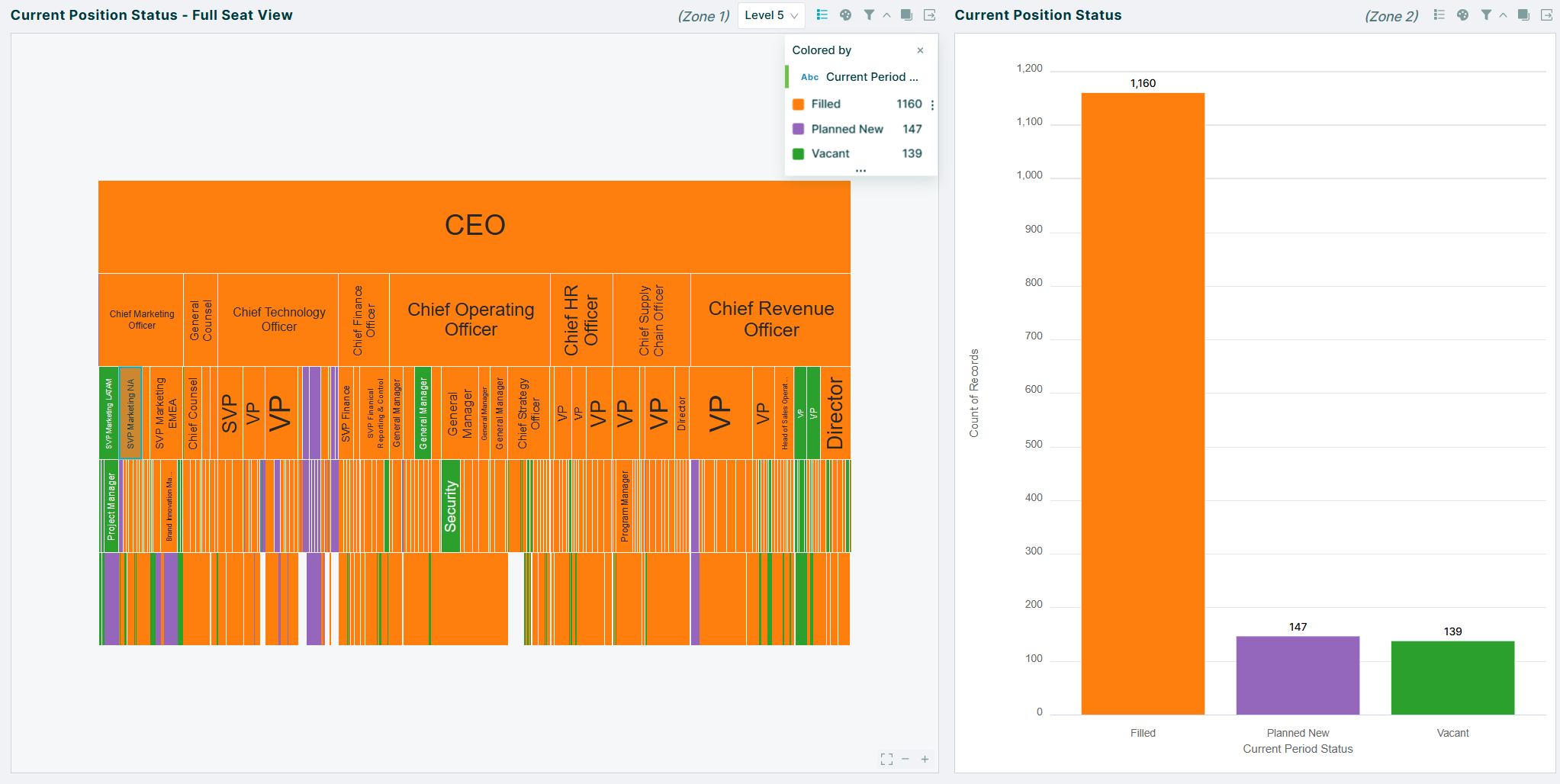
A Full Seat View of the organization distinguishing filled, vacant and approved positions
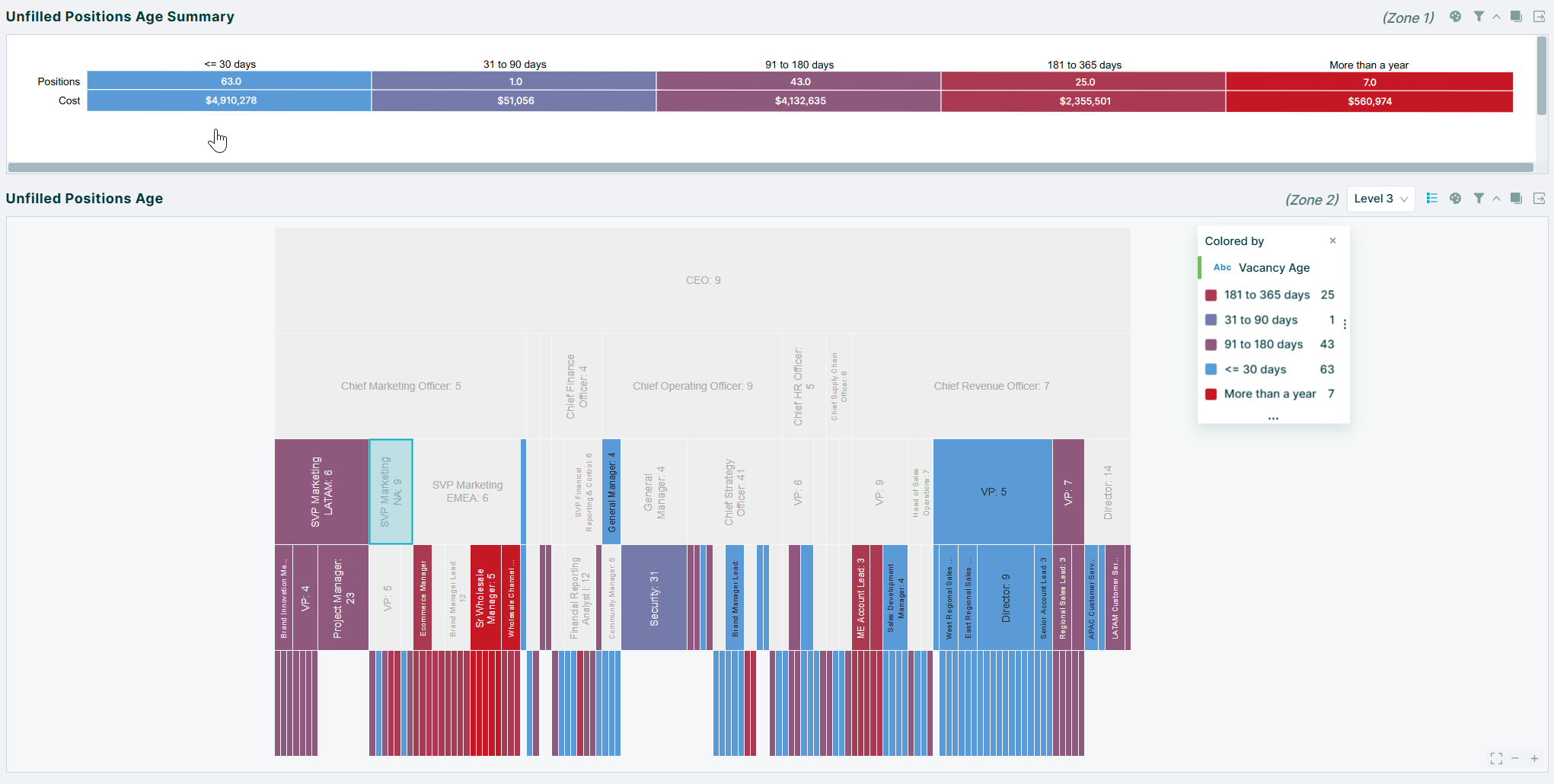
Transparency on the age and cost of vacant positions
Understand vacant positions:
- See the age and
,cost, of vacancies, and where these are found in the structure. - Identify where there are opportunities for human capital investments to be reallocated in line with business priorities.
Plan and model position changes
- Get immediate insight to identify the impact of planned changes
- Identify recruitment options to get the right mix of internal appointments and external recruitment
- Set planned start dates and immediately see the impact on cost and FTE.
- See the aggregate effect of multiple, individual actions taken across the organization at different points in time.
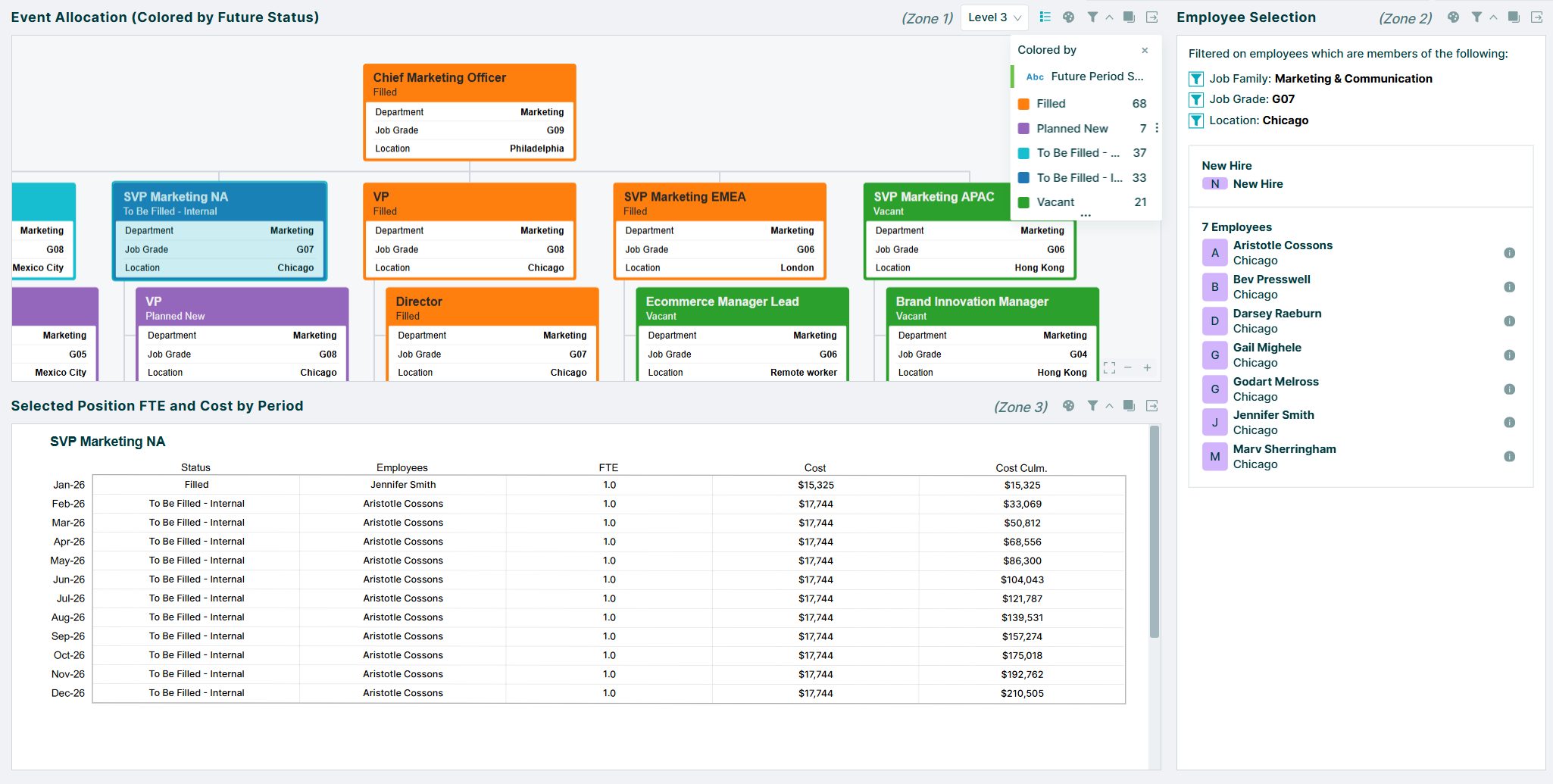
Model changes to your workforce and see its impact instantly
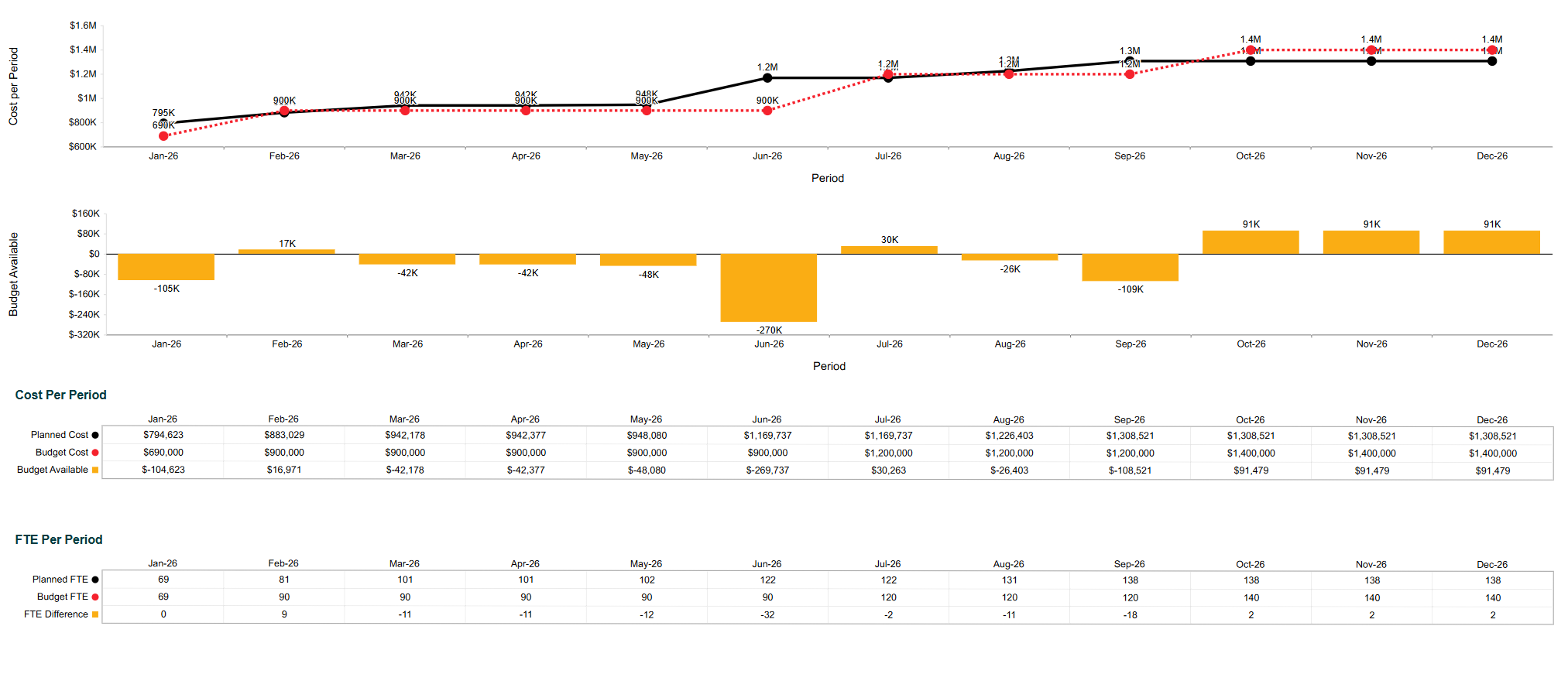
Future workforce size and cost by reporting period
Stay aligned to budget and targets
- Compare planned positions and hires against approved budgets
- See where you risk diverging from established targets to inform in-flight course correction.
Connect planning directly to the execution
- Track approved positions by status, including filled incumbents, internal moves, and planned hires.
- View hiring demand by start date to prioritise recruitment. Monitor recruitment status and ensure delivery remains aligned to the approved position plan.
- Get immediate insight needed by decision makers to inform approval decisions.
- See all approved new positions and group them by planned start dates (so you can prioritise)
- See recruitment status (Active, on hold or already recruited)
- Give talent acquisition teams a clear prioritised demand
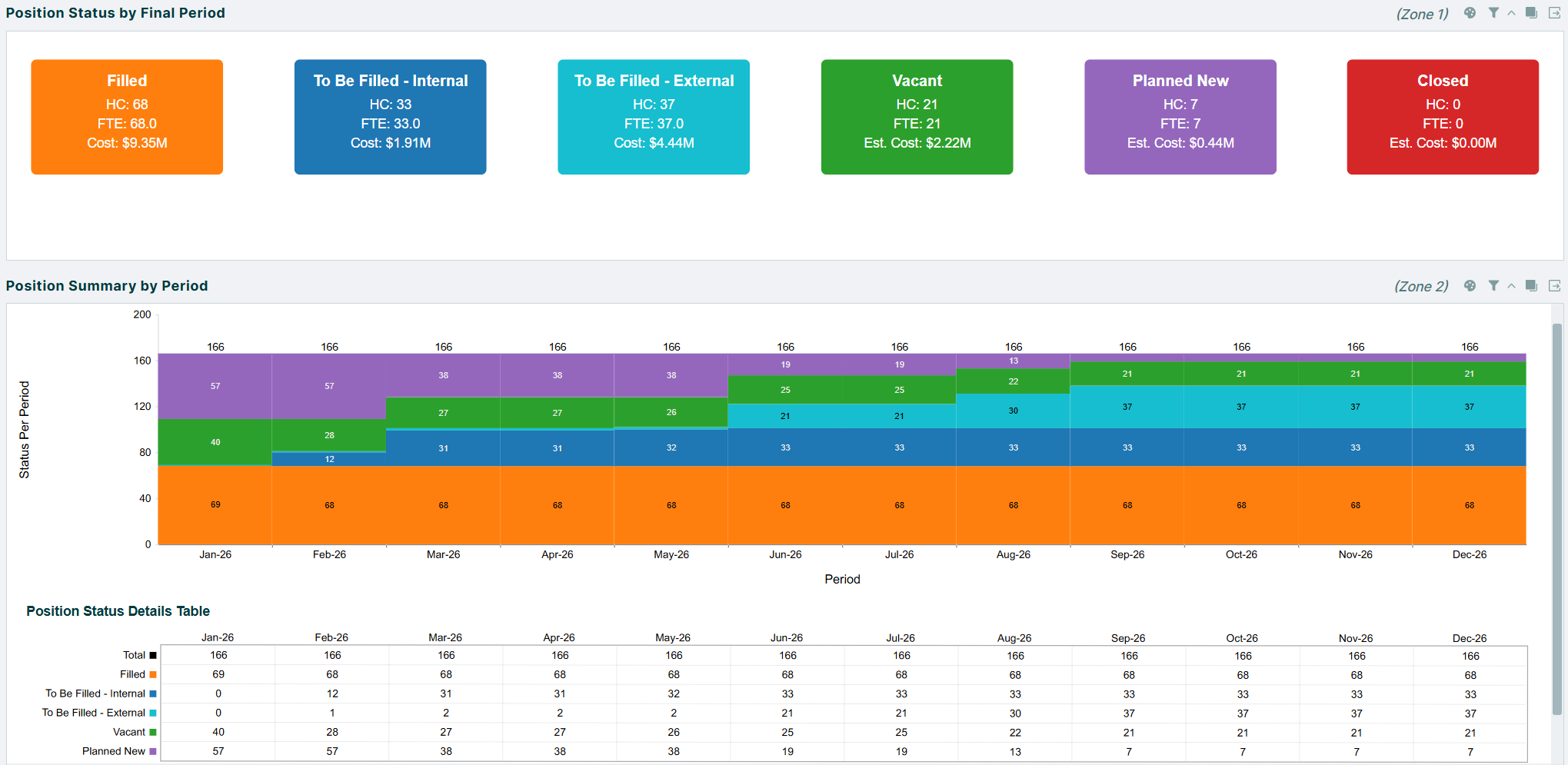
Forecast the workforce evolution by reporting period
Ready to see Orgvue in action?
In a personalized demo session, discover how Orgvue can help you:
- Understand workforce impacts before restructuring
- Compare multiple operating model scenarios
- Find critical skill gaps across the organization
- Align workforce plans to business strategy
- Accelerate AI workforce transformation
Trusted by global enterprises
“Orgvue’s automated role-clustering capability will save a huge amount of time in surfacing opportunities for organizational redesign, workforce planning, and cost reduction. What we’ve seen so far is truly game changing for design work.”
Stacy Anderson, Salesforce
Get your personalized demo
30-minute discovery call
Demo tailored to you
See our privacy notice. You can unsubscribe from marketing at any time by writing to us at [email protected].
Not ready for a demo? Explore more…



FAQ: Annual position planning
Annual position planning is the process of planning workforce size, structure, composition, and cost at the position level throughout the annual planning cycle. It helps organizations align workforce investments with business objectives, approved budgets, and strategic priorities.
Without ongoing position planning, workforce costs and organizational structures can gradually drift away from approved budgets and business priorities. Annual position planning gives HR and Finance a shared framework for managing workforce growth, vacancies, hiring demand, and structural changes before major corrective action becomes necessary.
Workforce planning focuses on ensuring the organization has the people, skills, and capabilities needed in the future. Annual position planning focuses specifically on managing positions, vacancies, headcount, workforce costs, and organizational structure over a defined planning cycle. Annual position planning often serves as an operational foundation for broader strategic workforce planning.
Annual position planning allows organizations to model position-level changes, forecast workforce costs, compare plans against budgets, and monitor workforce growth over time. This helps leaders identify potential overspend early and make adjustments before costs become difficult to manage.
Position-based planning is a workforce planning approach that uses positions rather than employees as the foundation for workforce management. It provides visibility into filled positions, vacant positions, planned hires, future workforce demand, and workforce costs, creating a more accurate view of organizational reality.
Annual position planning creates a shared source of truth for workforce data, allowing HR and Finance teams to work from the same position inventory, headcount assumptions, workforce costs, and planning scenarios. This improves alignment between financial plans and workforce decisions.
Most HRIS platforms provide employee and position management capabilities, but annual position planning requires forward-looking scenario modelling, workforce cost forecasting, vacancy analysis, approval workflows, and ongoing tracking of planned organizational changes. Many organizations use specialist workforce planning solutions to support these requirements at scale.
Headcount planning focuses on the total number of employees within an organization. Position planning provides a more detailed view by tracking individual positions, including filled roles, vacant positions, approved positions, planned hires, workforce costs, and reporting relationships.
Position planning connects workforce costs directly to organizational structures and approved positions. This enables organizations to forecast labor costs more accurately, compare plans to budget targets, and understand the workforce implications of financial decisions.
Vacant positions often represent significant budget commitments and future hiring demand. Understanding vacancy age, cost, location, and strategic importance helps organizations determine where positions should be filled, reallocated, redesigned, or removed.
By identifying workforce cost drift, structural inefficiencies, and budget variances earlier, annual position planning enables organizations to make smaller, incremental adjustments rather than relying on large-scale workforce restructuring programs to correct accumulated issues.
Scenario modeling allows organizations to test workforce changes before implementation. Leaders can evaluate the impact of new positions, hiring delays, role eliminations, reorganizations, vacancy reductions, and workforce investments on future headcount, costs, and organizational structure.
Organizations commonly track:
Workforce size and headcount
Filled versus vacant positions
Workforce costs
Hiring demand
Vacancy age
Budget versus actual workforce spend
Position creation and elimination
Organizational structure changes
Recruitment progress against approved plans
Annual position planning provides the workforce baseline needed for strategic workforce planning. It enables organizations to understand current workforce capacity, model future workforce needs, identify workforce gaps, and align talent strategies with business goals.
Orgvue provides a position-level view of the workforce, enabling organizations to manage workforce size, cost, structure, vacancies, hiring demand, and future workforce plans in a single environment. By bringing HR and Finance together around a shared workforce model, organizations can forecast workforce evolution, monitor delivery against targets, and make more informed workforce investment decisions.