Organizational benchmarking
Gain deeper insights into your business by benchmarking against peers
Trusted by global enterprises












Can benchmarking help you navigate Transformations?
In today’s rapidly evolving business landscape, 70% of transformations fail. The culprits? Stalling, lack of accountability, and inadequate planning. Many organizations struggle to gain clear, actionable insights into their workforce, leading to ineffective structuring and communication of these insights. This is where effective benchmarking comes into play, providing a powerful tool to guide and enhance transformation efforts.
So can you use benchmarking to increase your chances at transformation success?
What is benchmarking?
Benchmarking is an essential guide that informs intelligent workforce decisions. It provides a data-driven approach that ensures organizations set and strive toward common, quantifiable goals, thereby fostering alignment and accountability. The age-old principle of “what gets measured gets managed” is at the heart of successful organizational transformation. By measuring and comparing against industry peers or relevant benchmarks, organizations gain invaluable insights that drive deeper discussions with executives, explaining current operations and identifying areas for improvement.
Challenges addressed through effective benchmarking:
- Lack of clear organizational insightsDifficulty in structuring and communicating insights, or in stats supporting / confirming what a team might already know.
- Uncertainty of impactInability to determine whether workforce changes have a positive or negative impact.
- Unquantified opportunitiesDifficulty in identifying and quantifying opportunities for improvement.
- High risk due to uncertaintyUncertainty about direction increases the risk of failure.
Introducing Orgvue
Orgvue is a SaaS platform designed to help you optimize your workforce quickly and immediately, while also investing in long-term productivity and agility. As a leader in workforce transformation, it offers a comprehensive suite of products and services that can be used together or separately to achieve different objectives, and provides its customer with deep insights into organizational performance.
Workforce benchmarking with Orgvue enables data-driven decision-making to drive organizational transformation and design, ensuring alignment with strategic goals and quantifiable success. It can help you answer questions such as:
- How does your organization compare to peers in terms of size, structure, efficiency, and complexity?
- How do different functions vary in their spans of control, layers, and overheads?
- What are the best practices or design principles for your industry or organization size?
- How are your internal benchmarks aligned with external benchmarks?
- How are market trends and disruptions affecting your organization design and performance?

Analyzing benchmarks from different sources
At Orgvue, we offer different types of benchmarking, whether it’s bringing your own benchmarks, comparing against Orgvue’s extensive database of organizational metrics, or using labor market intelligence.
Contact our team to discuss the best approach for you.

Value of Orgvue’s Benchmarking capability:
Designed by transformation experts, Orgvue’ benchmarking solution provides organizations with the insights needed to drive successful transformations, whether at a point in time or continuous organizational design.
- Accelerate decision makingProvide data-driven, clear, and actionable insights. Identify and quantify opportunities for improvement and drive organizational action based on benchmark data.
- Boost confidenceBe sure of areas identified for improvement and validate hypotheses. Communicate with leadership using clear metrics and benchmarks to demonstrate progress and impact.
- Enhance leadership communicationAlways have quantifiable proof at hand, offering real metrics to validate and demonstrate success. Clearly measure the impact of transformations, and provide instant and clear visualizations for stakeholder communication.
How it works
External comparison
Use organizational structure benchmarking to monitor your organizational health by understanding core structural metrics and how they stack up against comparable industries and businesses of similar size.
You’ll be able to benchmark specific functions, against metrics such as Span of control, organizational layers, and much more.
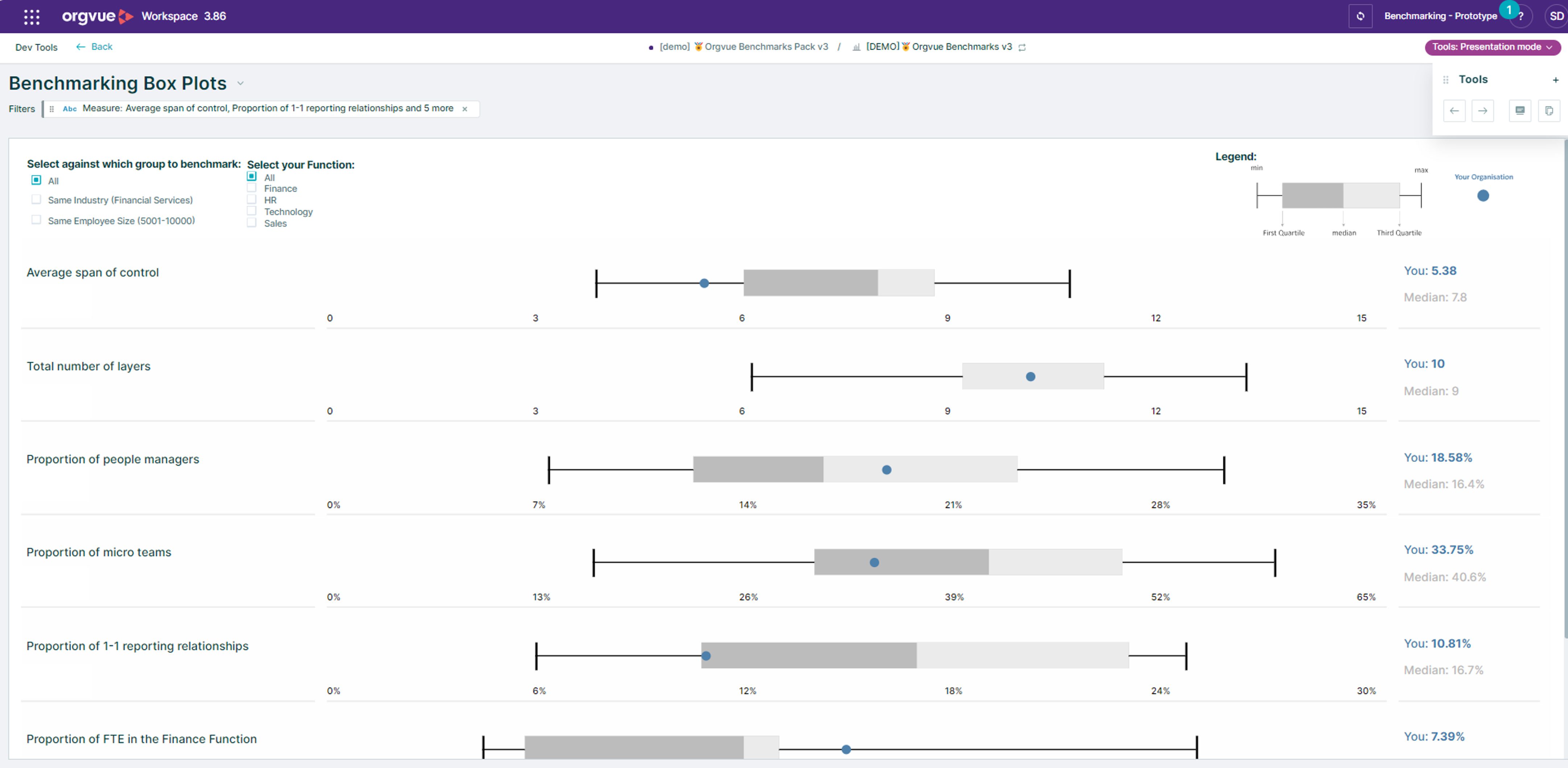
Compare core metrics to industry
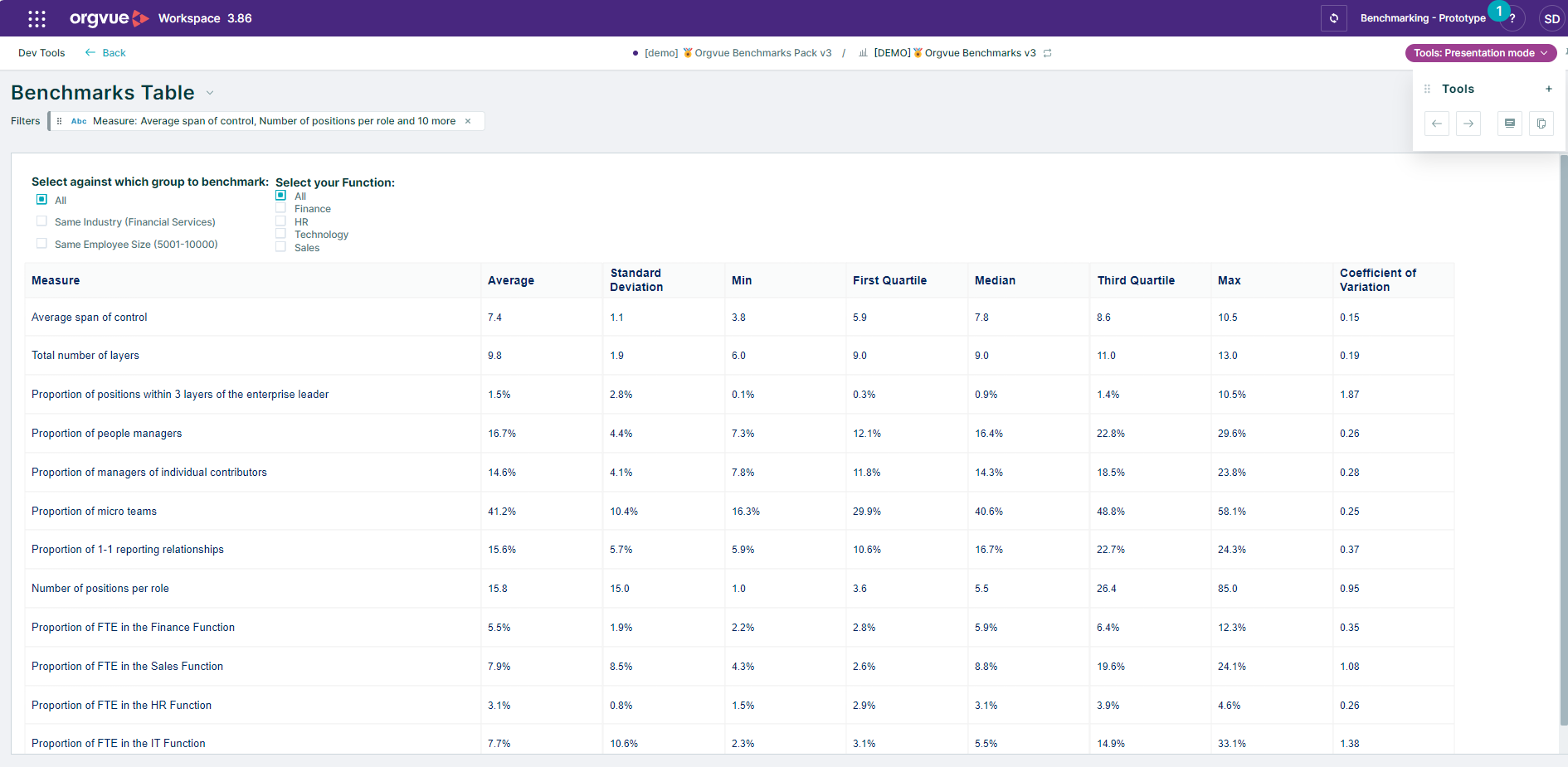
Evaluate against against key metrics and visualize organizational performance
Comprehensive dataset and visualization
Evaluate how your organization is doing against 17+ key metrics, and visualize organizational performance.
Detailed comparison vs. peer group
Monitor metrics filtered by organizational size and industry with the ability to deep-dive on specific functions.
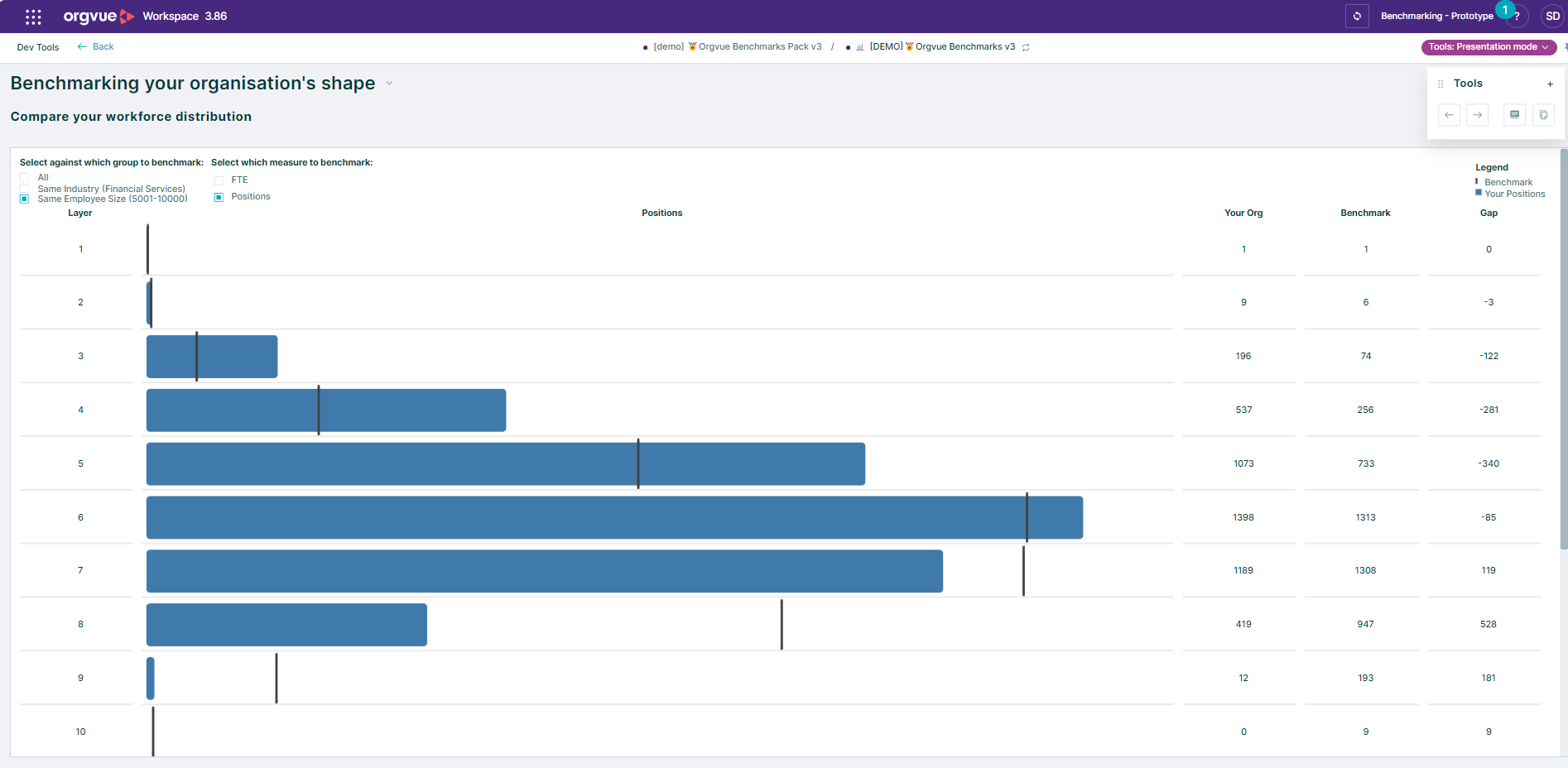
Benchmarking your organization’s shape against your industry
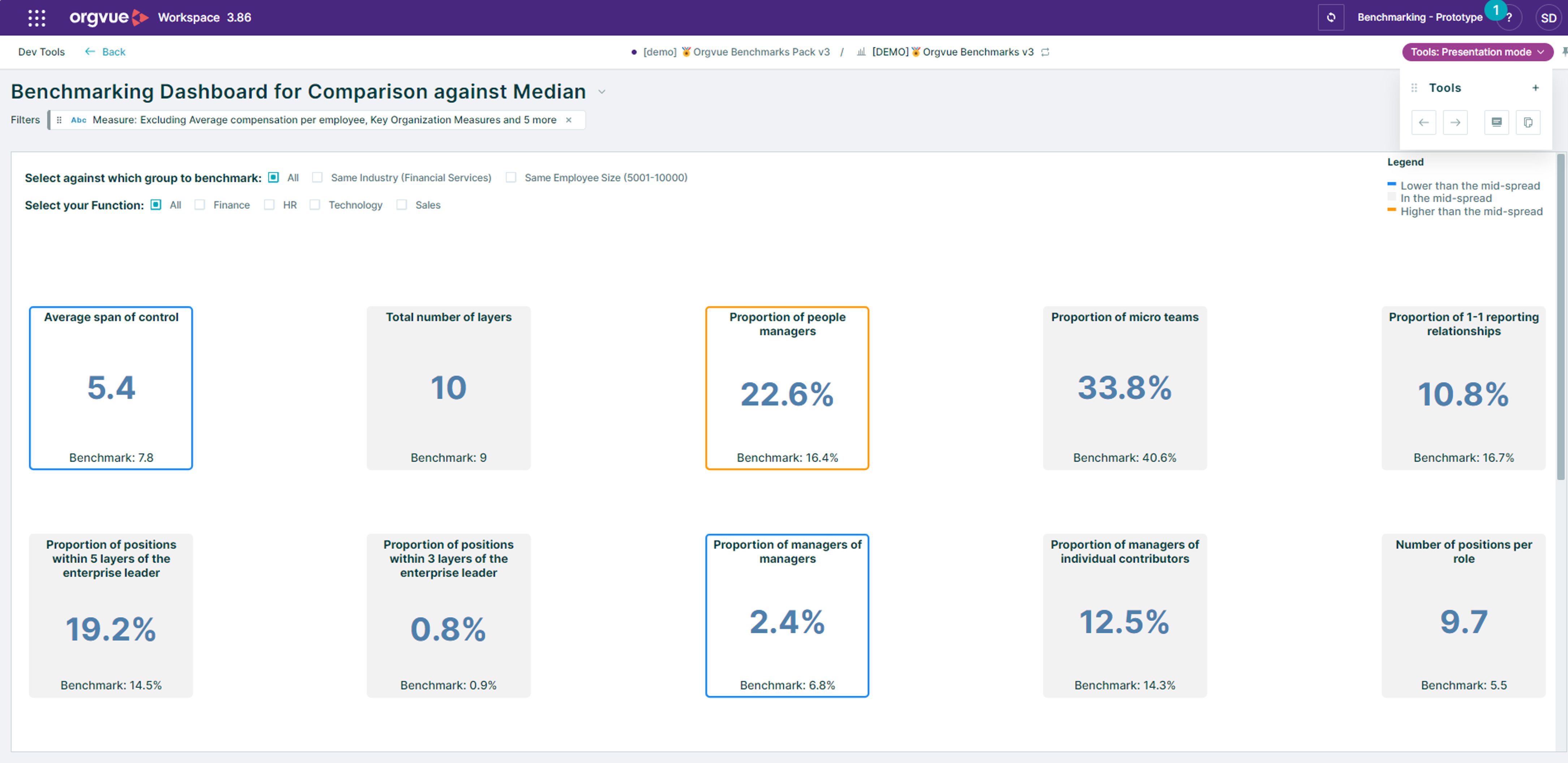
Example dashboard
Visual insights
Use interactive boxplots, dashboards, and charts to review your organizational metrics and shape
Quarterly insights
Get data refresh, quarterly reports and review sessions summarizing population, updates, and practical tips for interpreting results.
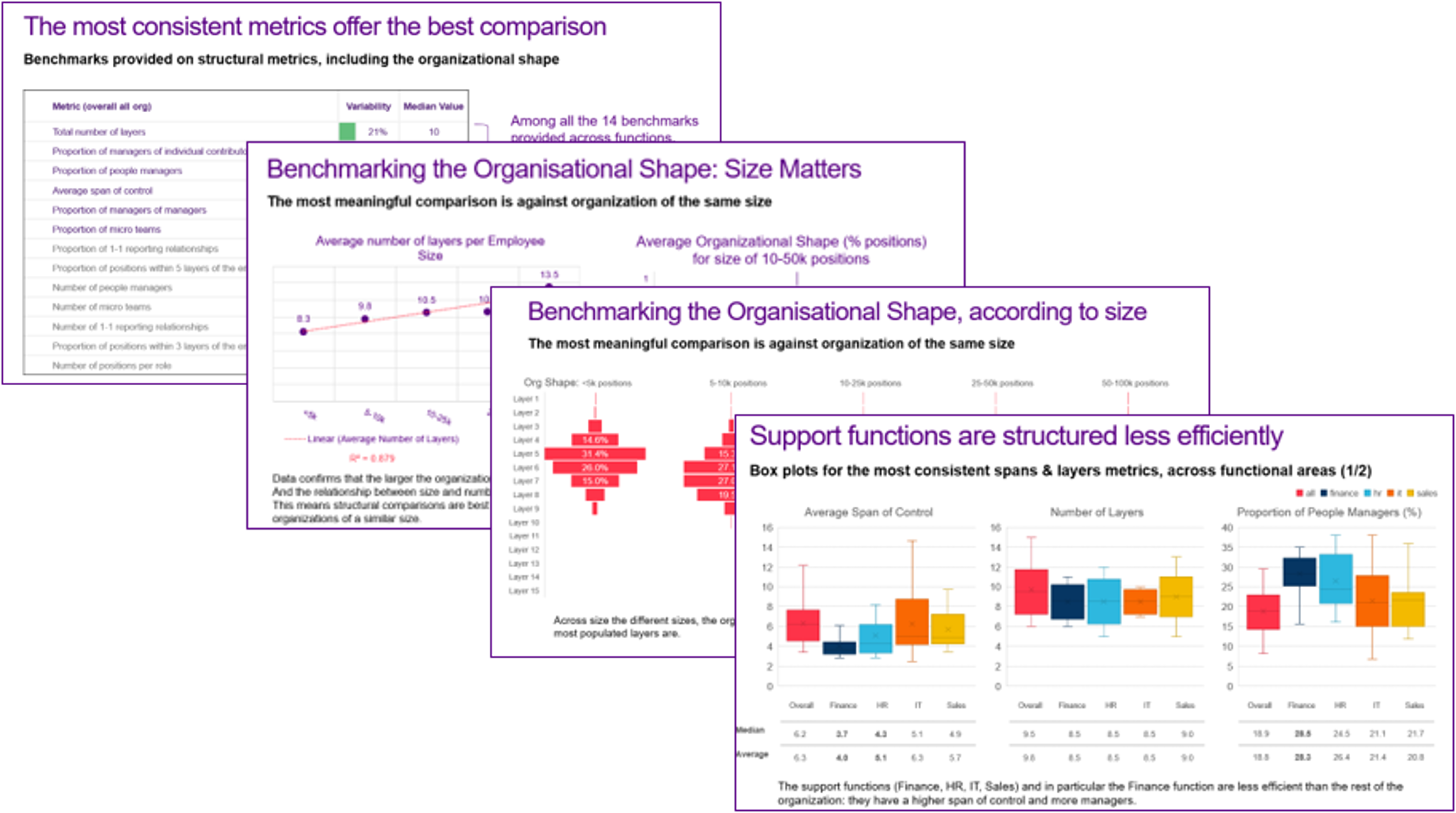
Example of quarterly reports
Ready to see Orgvue in action?
In a personalized demo session, discover how Orgvue can help you:
- Understand workforce impacts before restructuring
- Compare multiple operating model scenarios
- Find critical skill gaps across the organization
- Align workforce plans to business strategy
- Accelerate AI workforce transformation
Trusted by global enterprises
“Orgvue’s automated role-clustering capability will save a huge amount of time in surfacing opportunities for organizational redesign, workforce planning, and cost reduction. What we’ve seen so far is truly game changing for design work.”
Stacy Anderson, Salesforce
Get your personalized demo
30-minute discovery call
Demo tailored to you
See our privacy notice. You can unsubscribe from marketing at any time by writing to us at [email protected].
Not ready for a demo? Explore more…




FAQ: Organizational benchmarking
Organizational benchmarking is the process of comparing your organization’s structure, workforce metrics, and performance against peer organizations or established benchmarks. It helps leaders understand how their organization compares to similar businesses and identify opportunities to improve effectiveness, efficiency, and organizational health.
Organizational benchmarking provides objective context for decision-making. Instead of relying on assumptions, leaders can compare workforce metrics, organizational structures, and operating models against peers to identify risks, validate decisions, and prioritize improvement opportunities.
Benchmarking helps organizations establish realistic targets, measure progress, and evaluate whether transformation initiatives are delivering the expected outcomes. By comparing organizational performance against peers, leaders can identify improvement opportunities and focus resources where they will have the greatest impact.
Organizations commonly benchmark metrics such as spans of control, organizational layers, management ratios, workforce costs, workforce composition, headcount growth, contractor usage, turnover, diversity, and organizational complexity. These benchmarks help leaders assess organizational effectiveness and identify areas for improvement.
Span of control refers to the number of employees reporting directly to a manager. Benchmarking spans of control helps organizations identify management inefficiencies, understand leadership capacity, and evaluate whether structures are overly hierarchical or too lean.
Benchmarking provides evidence-based insights into how similar organizations are structured. This helps leaders evaluate management layers, team sizes, reporting structures, and organizational complexity, creating a stronger foundation for organizational design decisions.
Internal benchmarking compares different parts of the same organization, such as departments, regions, or business units. External benchmarking compares an organization against industry peers or broader market data to provide additional context on performance and organizational effectiveness.
Organizations should benchmark workforce metrics regularly to understand trends and changing conditions. Quarterly or annual benchmarking reviews are common and help leaders track progress, monitor organizational health, and adapt to market changes more effectively.
Yes. Benchmarking can reveal differences in workforce costs, management structures, organizational layers, and operational efficiency when compared with peer organizations. These insights help leaders identify opportunities to simplify structures, improve productivity, and reduce unnecessary costs.
Orgvue combines workforce, organizational, and financial data with benchmarking insights to help organizations compare themselves against peers, monitor key organizational metrics, identify improvement opportunities, and support data-driven workforce transformation and organizational design decisions.