Job architecture
Build a clear, consistent structure for intentional workforce planning by clarifying roles, organizing data, and enabling adaptability to shifting markets and new technologies.
Trusted by global enterprises












What is job architecture?
Job architecture is the framework that defines and organizes roles across your organization, grouping them by family, level, and makes it easier to understand the work they’re meant to deliver.
It creates a clear, consistent structure that improves workforce planning, brings transparency to pay and progression, and helps you manage costs and identify skill gaps. With this foundation, you can respond to immediate pressures with confidence while building toward ongoing workforce intelligence.
The importance of job architecture in workforce planning
Want to know more?
The challenges of building a job architecture
With thousands of positions to align, organizations often struggle with:
- Keeping structures current as work evolves, especially when job architecture is treated as a one-time project
- Navigating regional variations, inconsistent titles, and overlapping roles that make standardization difficult
- Working around outdated systems
- Outdated HR systems and unstructured data that lacks necessary fields for job architecture
- Inadequate job leveling that leads to pay compression and regional disparities

We had people with different titles doing the same work, and people with the same title doing different work; they had different grades and different compensation. It was chaos. It was impossible to plan the organization.
Orgvue partner
Job architecture: Building the foundation for organization design and workforce planning
Turn messy positions data into a structured architecture with Orgvue
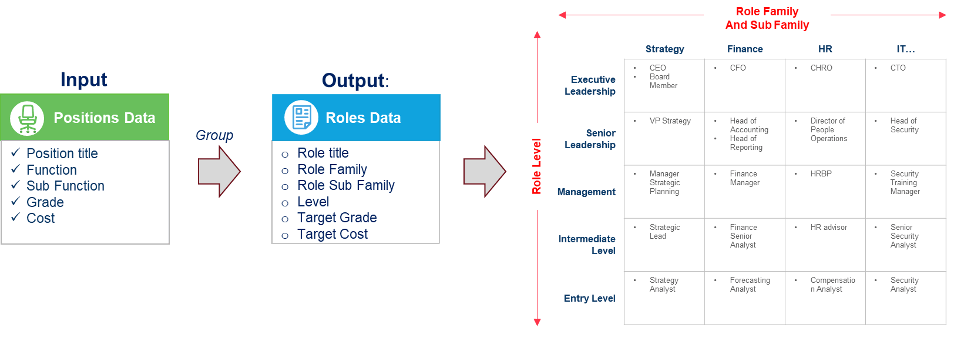
With Orgvue, you can rapidly group thousands of position records into clearly defined roles, clusters, and job families, creating structure where none existed before.
- Strengthen your architecture with Orgvue’s role grid builder, defining role families and levels that support skills planning, reward decisions, and career pathways.
- Automate the hardest and most time-consuming work with Henshaw Roles AI, converting messy position data into coherent role clusters in a fraction of the time.
use cases
Simplify organizational data to enable intentional planning
AI Automated clustering accelerates the creation of role data, making the process faster, more reliable and auditable, tailored to your organizational context.

Organization and AI transformation
Clustering roles gives you a macro view of the workforce, reducing complexity and creates the foundation for workforce, succession and skills planning.
- Create framework for new job structures, pay grades and career paths
- Reveal how demand shifts as work changes
- Identify opportunities to retrain and reallocate resource

Mergers and Acquisitions
Aggregate labor cost, headcount and job level data from multiple sources and standardize across businesses for consistent views and assessment.
- Reveal available skills at different levels in the organization across specific job families
- Compare pay practices across the organizations
- Instead of layoffs, use job architecture to identify transferable skills and redeploy

Workforce Planning
Fast track your planning baseline with a job architecture that links work to roles and skills.
- Identify current and future skills gaps
- Build training, succession, and promotion plans
- Feed plans into HR systems for execution
“Henshaw AI has significantly accelerated our Org Design and workforce planning efforts, expediting an otherwise manual approach, and reducing the timeline by at least six months.”
VP of Org Design
Features and benefits
How Orgvue simplifies job architecture
Unify and assess current positions data
Orgvue brings together data from finance, HCM, and regional systems into a single, trusted view so organizations can assess their starting point and build toward ongoing workforce intelligence.
Answer questions like:
- Which grades have the most positions?
- How many positions and position titles exist?
- Where is title proliferation creating unnecessary complexity?
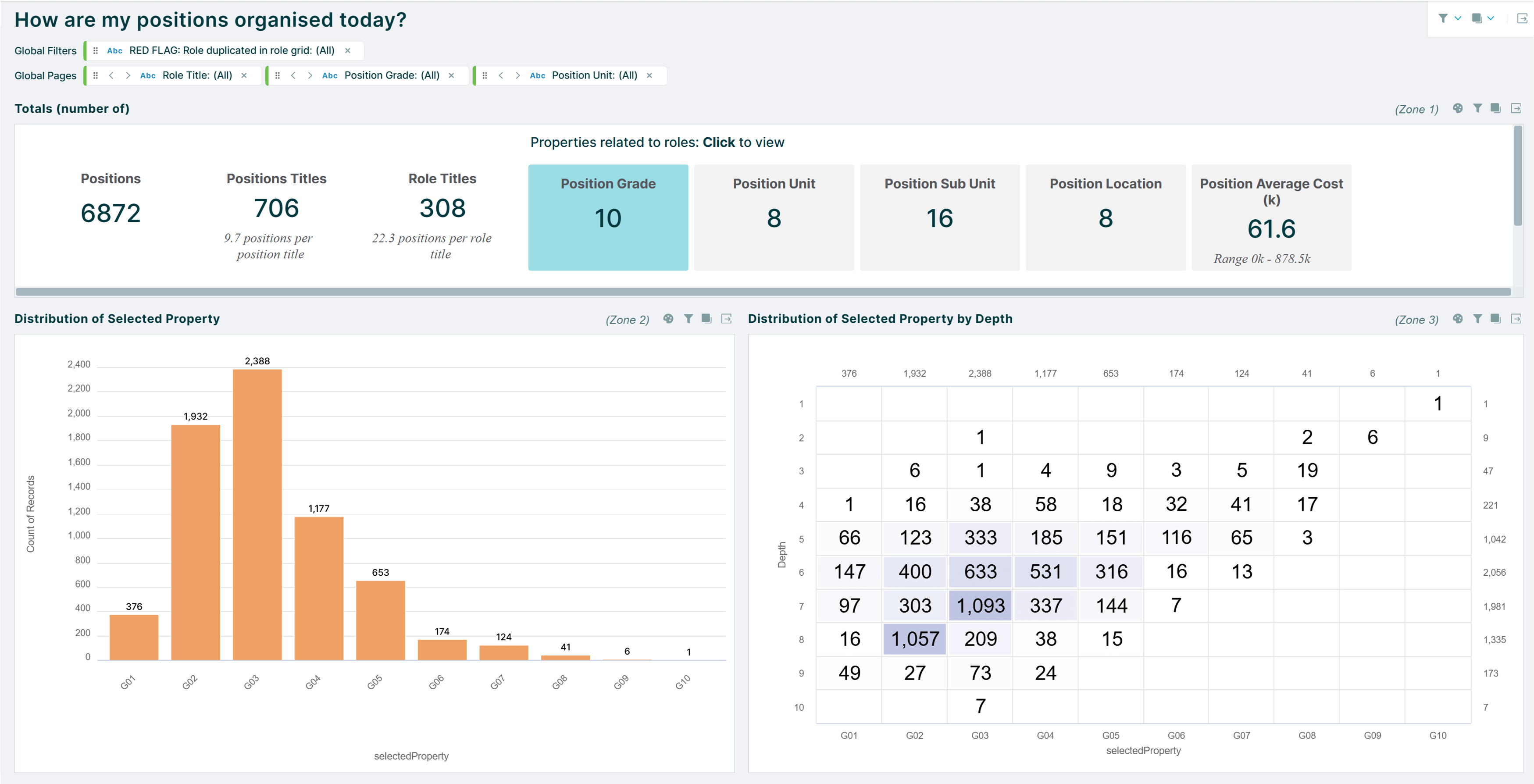
Understand the position data in more detail
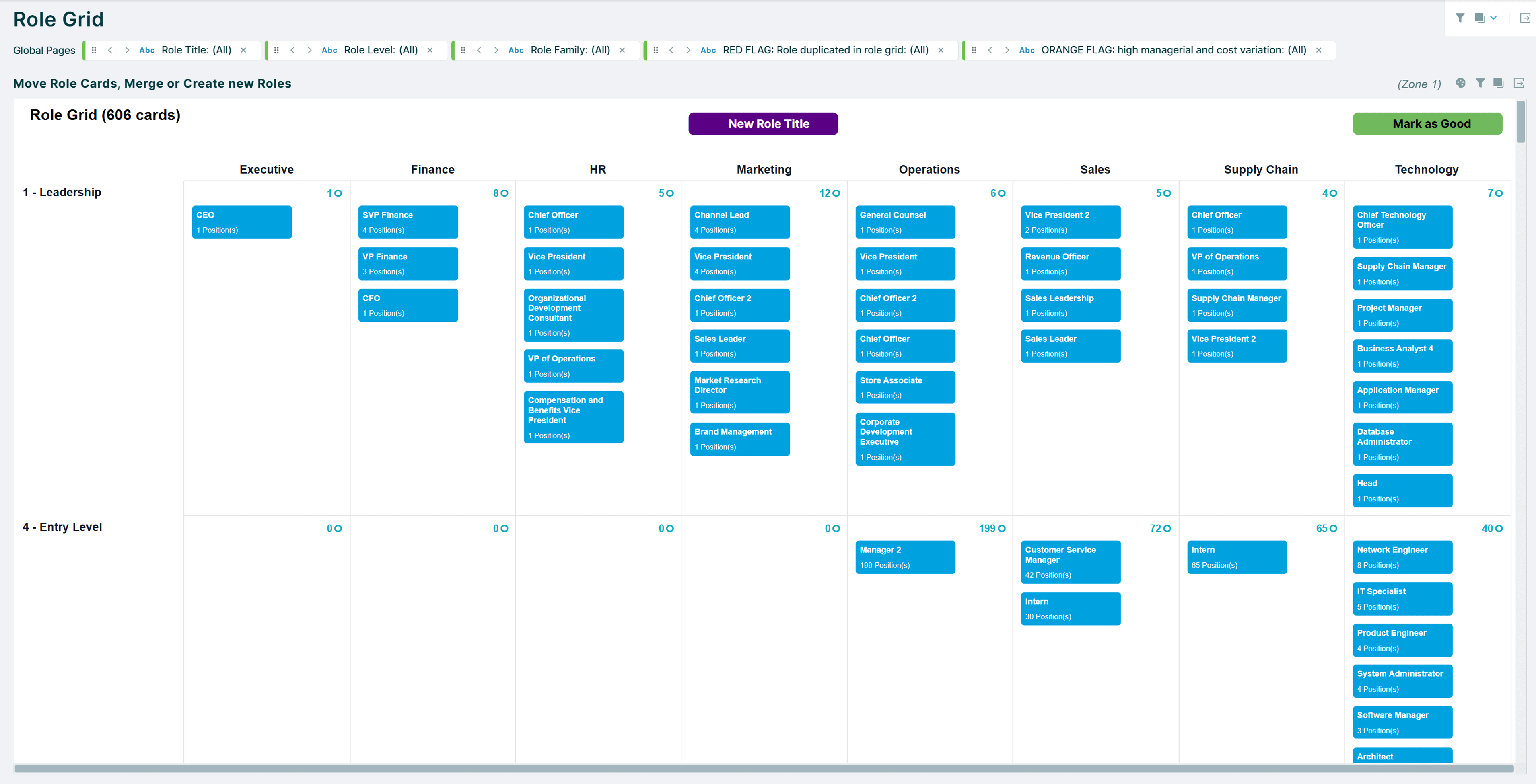
View clustered roles across levels to reveal gaps and areas of risk
Aggregate positions into roles with AI and build the role grid
- Use Henshaw Roles to group similar positions into role clusters that reflect how work is done
- Transfer clusters into the role grid, cross-referencing them with organizational level and role complexity
- Refine groupings in the grid, consolidating or creating new jobs as the structure is validated
Review the role grid
Use Orgvue’s pre-built analysis templates to assess and correct issues in your taxonomy.
Answer questions like:
- Are there red flags, duplications, or roles without positions?
- Where do the same roles appear across multiple managerial levels?
- Which role titles show wide variation in cost or accountabilities?
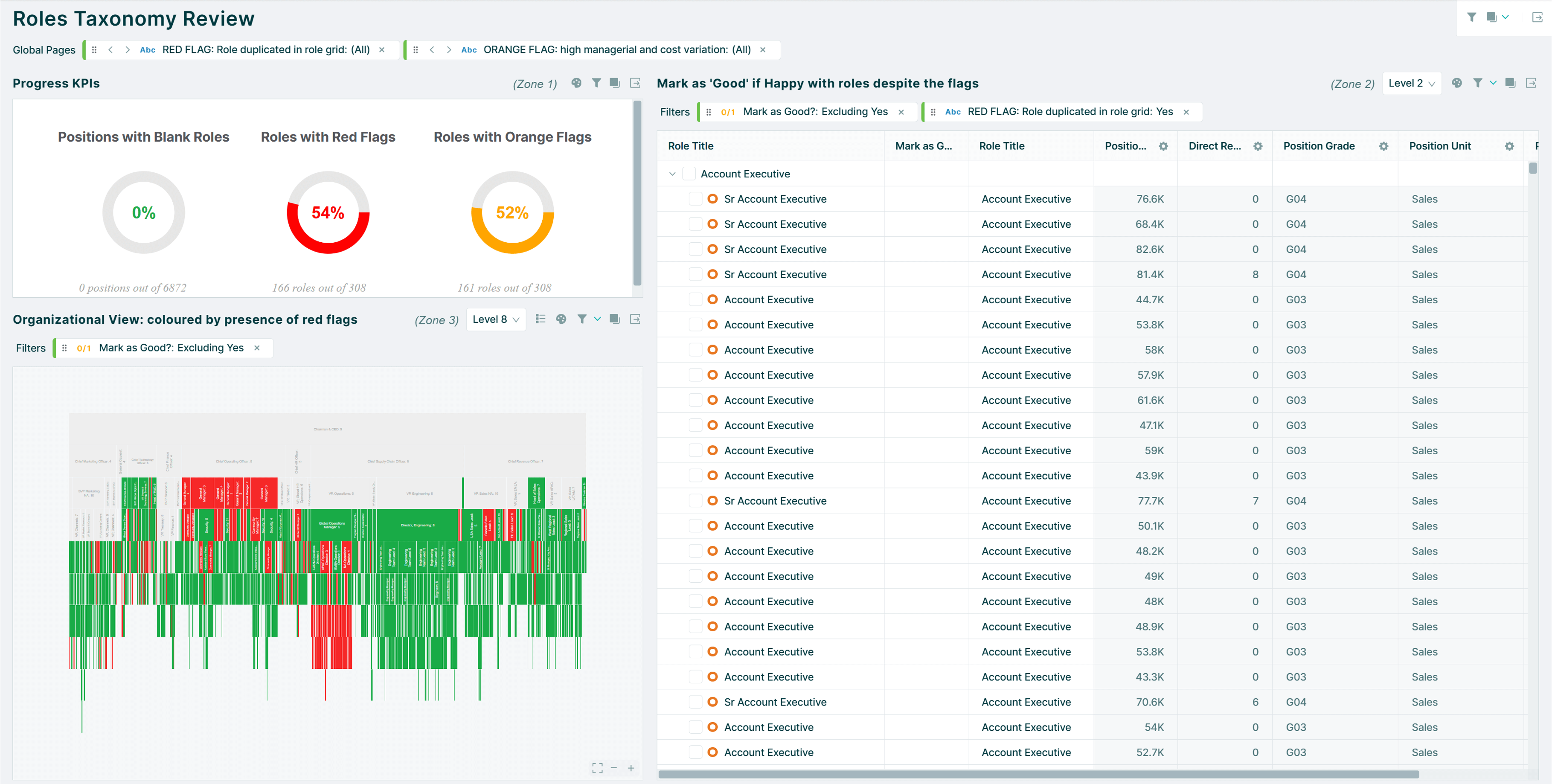
Reveal risks in your role taxonomy and correct them as you build the architecture
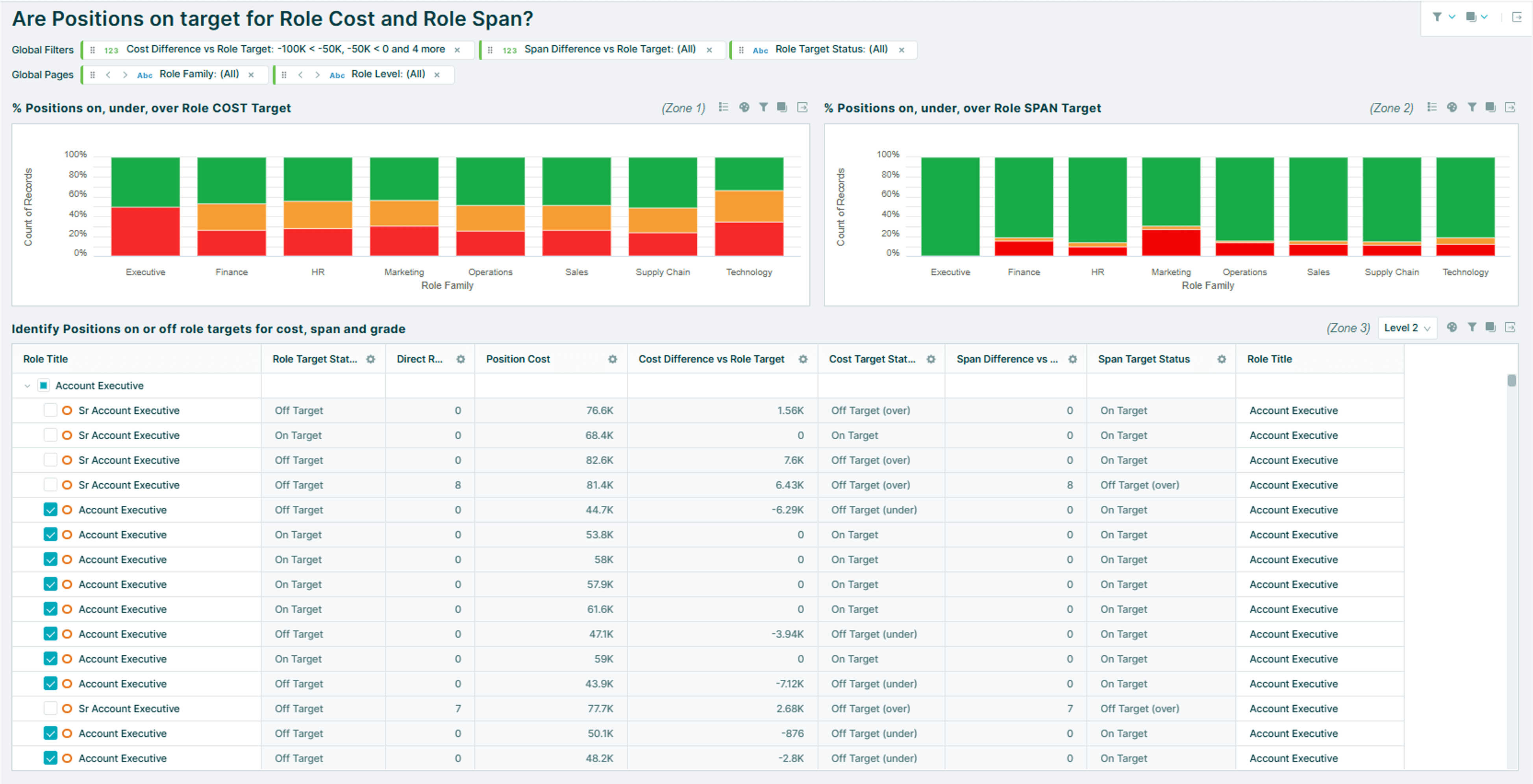
Flag where positions sit against role cost and role span targets
Add additional role data
- Enhance your data infrastructure with more granular fields to support micro-level design
- Set targets for accountabilities, activities, and skills at each level to strengthen role clarity and future planning
Henshaw Assistant

Ask, and your data answers
Henshaw Assistant brings your data to life, giving you instant clarity on your workforce
Ask questions like:
- How many unique job families are there in my organization?
- How many unique jobs are in each job family?
Ready to see Orgvue in action?
In a personalized demo session, discover how Orgvue can help you:
- Understand workforce impacts before restructuring
- Compare multiple operating model scenarios
- Find critical skill gaps across the organization
- Align workforce plans to business strategy
- Accelerate AI workforce transformation
Trusted by global enterprises
“Orgvue’s automated role-clustering capability will save a huge amount of time in surfacing opportunities for organizational redesign, workforce planning, and cost reduction. What we’ve seen so far is truly game changing for design work.”
Stacy Anderson, Salesforce
Get your personalized demo
30-minute discovery call
Demo tailored to you
See our privacy notice. You can unsubscribe from marketing at any time by writing to us at [email protected].
Not ready for a demo? Explore more…




FAQ: Job architecture
Job architecture provides a consistent framework for understanding roles, levels, skills, and career paths across the organization. By creating a common language for work, it helps organizations identify skills gaps, forecast future workforce needs, improve succession planning, and make more informed workforce investment decisions.
Organizational structure defines reporting relationships and how teams are organized. Job architecture defines the roles within those structures, including job families, career levels, skills, responsibilities, and progression paths. Together, they create the foundation for effective workforce planning and organizational design.
Job architecture connects roles, skills, and career levels into a structured framework. This helps organizations understand current workforce capabilities, identify emerging skills requirements, detect skills gaps, and build targeted development, recruitment, and reskilling strategies.
Yes. Job architecture helps organizations compare roles, job levels, compensation structures, and skills across multiple companies. This makes it easier to standardize workforce data, identify overlaps, evaluate workforce capabilities, and create a consistent approach to workforce integration following a merger or acquisition.
AI can analyze large volumes of workforce and position data to identify patterns, group similar roles, and create role clusters more efficiently than manual approaches. This accelerates the creation of job architectures while improving consistency, auditability, and the ability to maintain structures as organizations evolve.
Job families are groupings of roles with similar skills, and professional qualifications and exist across a number of levels in the organization, like Finance, Marketing or Engineering. A role cluster is a grouping of roles or positions that represent an organizational capability, defined by the work it enables, such as Junior Software Engineers (consisting of Junior front end engineers, junior back-end engineers, junior QA engineers).
In Strategic Workforce Planning, Succession Planning or Skills Initiatives, these groupings provide a macro-level view for planning but range from broad job families to granular job levels to incorporate each organization’s specific content.
Henshaw is Orgvue’s AI capability designed to accelerate organizational clarity and empower faster, smarter decisions about work and workforce. It applies generative AI and machine learning directly within Orgvue to automate structural insight, reduce manual effort, and reveal opportunities for change.
Henshaw will enable users to:
1. Work more efficiently – augment more tasks with AI
2. Manage and interpret the data more intelligently
3. Drive to outcomes more decisively – confidence in output
By learning from the business’s titles and only then clustering and naming, Henshaw produces Role Clusters that are faithful to the actual capabilities of your unique business. Henshaw Roles gives an accurate picture of the organization, specifically because it learns from your org context rather than forcing a generic schema. This makes the output far more relevant to planning for that business.
Automated, mathematical driven and AI powered Role Clustering is simply more reliable than human judgment. People bring bias (familiar titles, politics, recent examples) and make inconsistent calls when titles are messy, or workloads are large. Our method applies the same rules to every position and produces clusters that are reproducible and auditable. The result is a faster, fairer, and more defensible view of your real capabilities.
Orgvue is a Software as a Service (SaaS) solution. This ensures that all of our customers benefit from robust and consistent security measures, data management policies, and service level commitments. More details are available from our Orgvue Trust Center.
All Orgvue Henshaw capabilities are opt-in only, per tenant and per capability. This ensures separation of data per customer and per AI use-case. This means no data is shared back to any LLMs (Large Language Models). Information on OpenAI Privacy is available at: https://openai.com/enterprise-privacy/