Talent intelligence
Bring external labor market insight into your workforce data to see where you stand.
Trusted by global enterprises








Understanding the challenge
Understanding how your organization performs compared to the external market is no longer a luxury—it’s essential. Critical questions such as “Are we paying competitively? Which roles are at risk of turnover or automation? Where do we face the greatest hiring challenges?” demand quick, actionable answers. These are some of the most difficult challenges to address in today’s environment, yet many organizations still lack the processes needed to tackle them effectively.
Want to know more?
That’s where Orgvue comes in
Orgvue changes the game. By integrating internal workforce data with external labor market intelligence, Orgvue offers a comprehensive, contextualized view of your organization. This empowers you to make faster, smarter decisions aligned with market trends and organizational goals.
Orgvue lets you map your organizational data to external market data, visualize it, and model it—all within a single platform. With Orgvue, you can:
- Visualize internal and market data side-by-side
- Gain deep insights into roles and skills
- Use insights to guide organizational design, evaluate talent sourcing strategies, and assess the feasibility of proposed changes
How it works
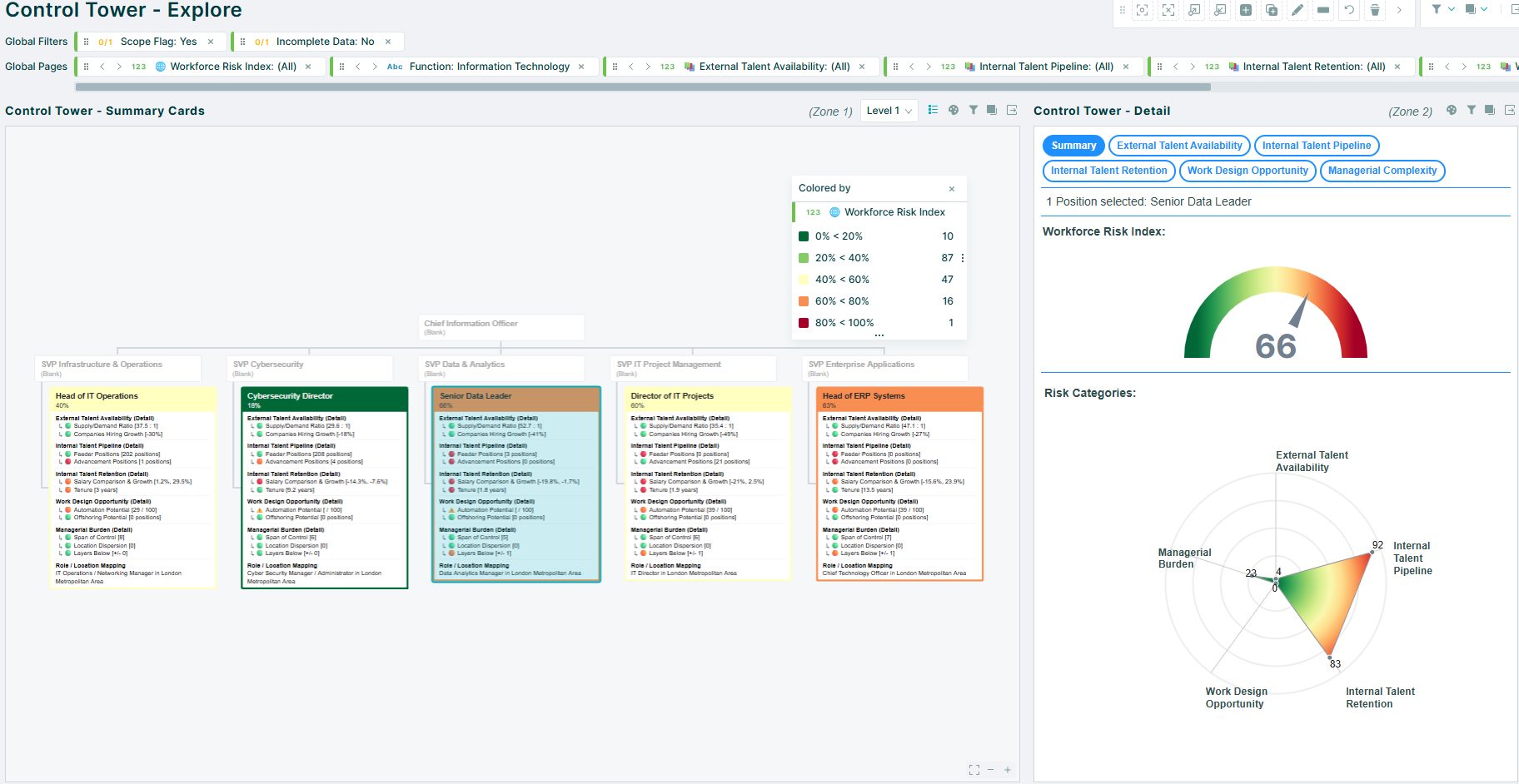
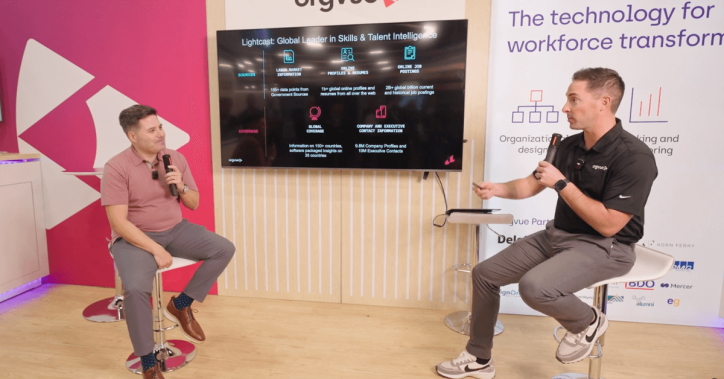
Orgvue makes external labor market insights instantly accessible and actionable. Through partnerships with leading providers like Lightcast and Revelio Labs, as well as our strategic alliance consulting partner Deloitte, Orgvue integrates AI-driven labor market data from over 70,000 global sources directly into its platform. This data sits alongside your internal organizational data, enabling you to compare, identify risks, and make informed decisions with ease.
Key insights include:
- Job demand and supply
- Compensation benchmarks
- Automation potential of roles and tasks
- Skills demand and supply
Orgvue’s intuitive platform allows you to interact with real-time external and internal data side-by-side, streamlining the decision-making process.


Putting this into action
Discover how talent intelligence integrates with your data.
Some of the most common use cases
Skills-based organizations
Strengthen workforce planning, role design, and reskilling by identifying in-demand skills across the market and your organization and assessing where gaps or sourcing challenges exist.

Strategic workforce planning
Develop actionable workforce plans tailored to market conditions and internal capabilities. Address talent gaps by analyzing supply and demand and evaluating build, buy, and borrow strategies.

Automation potential
Navigate AI’s impact on work by identifying which roles, tasks, and activities are best suited for automation and where human expertise remains essential.

Location strategy
Benchmark salaries, assess workforce availability and skill levels, and calculate labor costs across locations. Use these insights to evaluate offshoring opportunities and align with financial and operational goals.

Mergers and acquisitions
Mitigate talent and turnover risk during periods of disruption by pinpointing roles most at risk and identifying critical employees with in-demand skills. Use these insights to shape retention strategies that protect business continuity.
Functional benchmarking
Compare core functions like HR, Finance, and IT against market peers to identify gaps, skills needs, and sourcing priorities, and assess the financial and operational impact of moving to a new operating model.
Key capabilities
Assess
- Role mapping: Map your jobs to market standard role taxonomies and expected skill profiles
- Workforce risk assessment: Identify pockets of risk related to retaining critical talent and how jobs are expected to be disrupted –
- Competitive benchmarking: Compare headcount against industry peers at the enterprise or functional levels
- Skills gap assessment: Accelerate skills taxonomy and skills target development and reference market data to inform sourcing strategies for targeted skills gaps (Build, Buy, Borrow)
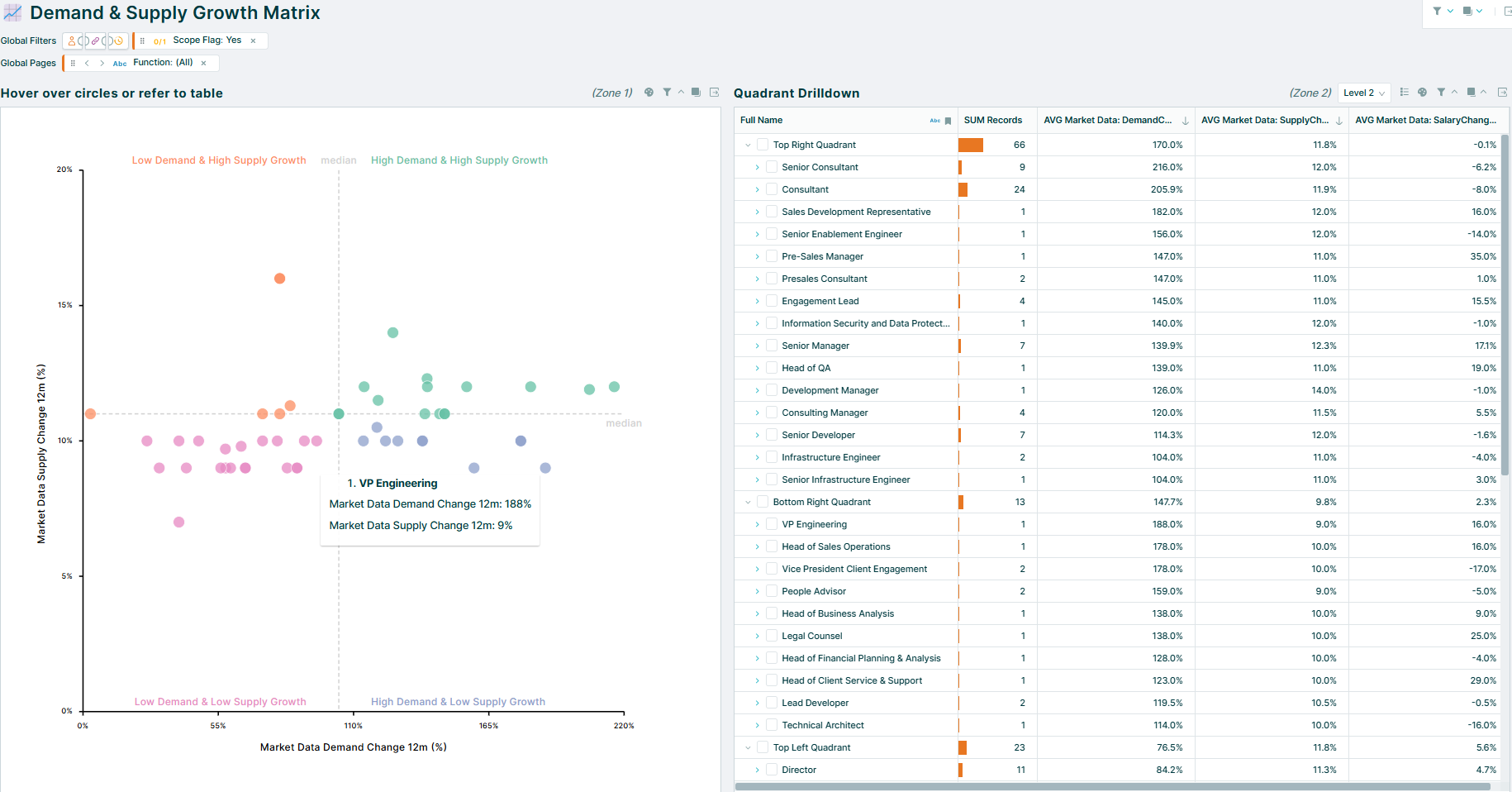
Using Labor Market Intelligence for competitive assessment in Orgvue
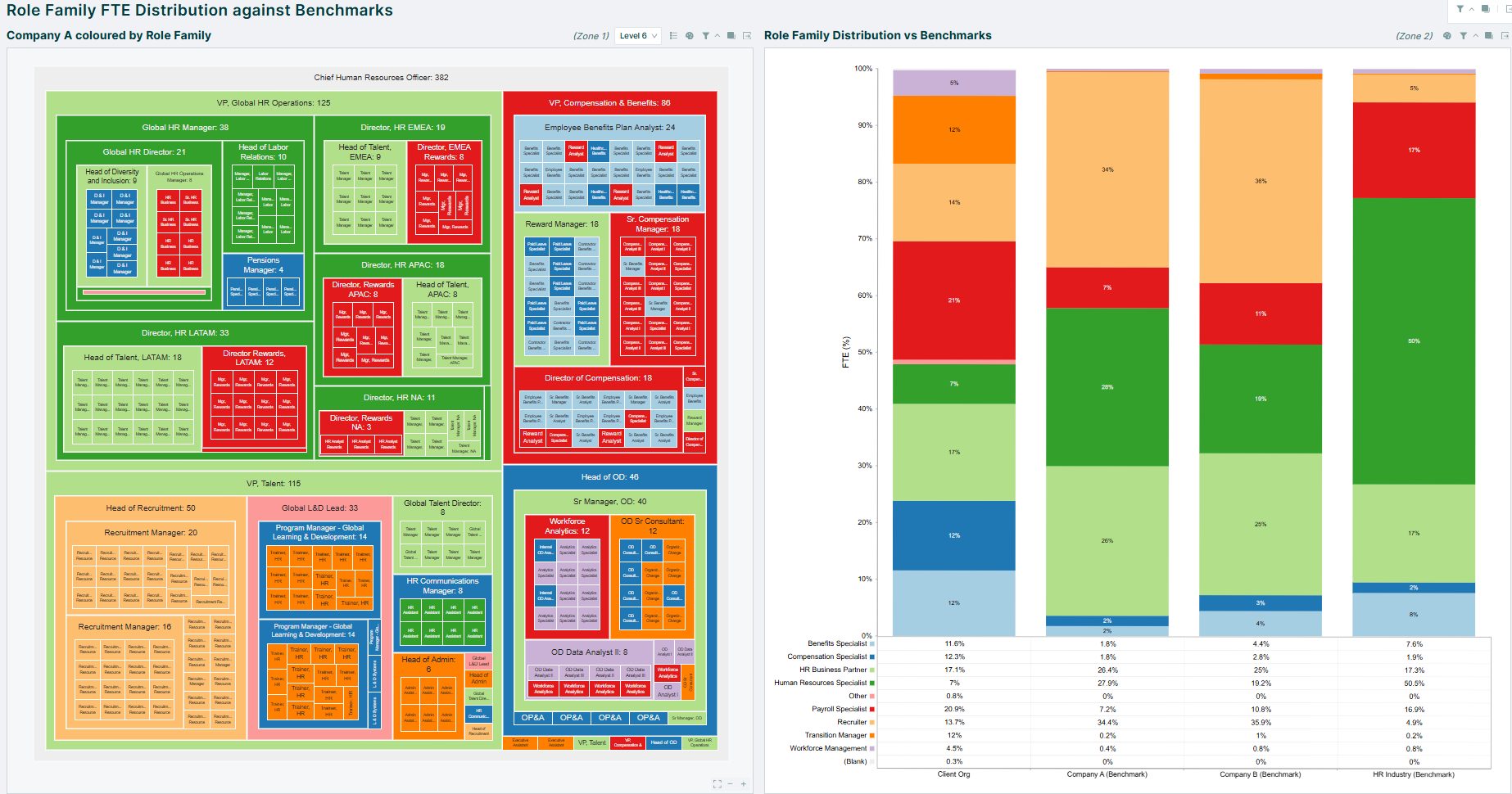
Using Labor Market Intelligence to design and plan in Orgvue
Design and Plan
- Workforce planning: Accelerate role clustering and definition of demand assumptions to support longer-term planning
- Org design feasibility: Understand the availability of talent and skills and target compensation for relocation or growth scenario planning
- Job architecture: Accelerate job analysis and job grid design, as well as compensation planning and career pathing scenarios
Ready to see Orgvue in action?
In a personalized demo session, discover how Orgvue can help you:
- Understand workforce impacts before restructuring
- Compare multiple operating model scenarios
- Find critical skill gaps across the organization
- Align workforce plans to business strategy
- Accelerate AI workforce transformation
Trusted by global enterprises
“Orgvue’s automated role-clustering capability will save a huge amount of time in surfacing opportunities for organizational redesign, workforce planning, and cost reduction. What we’ve seen so far is truly game changing for design work.”
Stacy Anderson, Salesforce
Get your personalized demo
30-minute discovery call
Demo tailored to you
See our privacy notice. You can unsubscribe from marketing at any time by writing to us at [email protected].
Not ready for a demo? Explore more…



FAQ: Talent intelligence
Talent intelligence is the practice of combining internal workforce data with external labor market data to create a more complete view of talent, skills, compensation, workforce trends, and hiring conditions. It helps organizations make more informed workforce and talent decisions.
Talent intelligence provides the external context needed to understand how your workforce compares to the market. It helps leaders make better decisions about hiring, skills development, workforce planning, compensation, retention, and organizational design.
Labor market intelligence is data about workforce supply, demand, compensation, skills, hiring trends, and employment patterns across industries and geographies. Organizations use it to understand talent availability and benchmark workforce decisions against external market conditions.
Talent intelligence helps organizations understand the availability of talent, future skills demand, labor market trends, and workforce risks. This enables more effective strategic workforce planning and helps organizations develop realistic plans based on actual market conditions.
Talent intelligence helps identify risks such as talent shortages, skills gaps, compensation pressures, attrition risk, automation exposure, and difficulty recruiting for critical roles. These insights help leaders take proactive action before workforce challenges impact business performance.
Talent intelligence helps organizations understand which skills are growing in demand, which capabilities are becoming scarce, and where internal gaps exist. This allows leaders to prioritize hiring, reskilling, upskilling, and workforce development efforts more effectively.
Talent intelligence provides insight into workforce availability, local compensation benchmarks, skills concentrations, hiring competition, and labor costs across different regions. Organizations can use this information to evaluate expansion, relocation, outsourcing, or offshoring opportunities.
Talent intelligence helps organizations identify which roles and skills are most exposed to automation, understand emerging talent requirements, and develop workforce strategies that balance technology adoption with human capability development.
Workforce analytics focuses primarily on internal workforce data such as headcount, turnover, costs, and demographics. Talent intelligence combines internal workforce data with external labor market insights, providing additional context for workforce and talent decisions.
Orgvue combines workforce, organizational, skills, and cost data with external labor market intelligence to provide a comprehensive view of talent supply, demand, workforce risk, compensation benchmarks, automation exposure, and skills availability. This helps organizations make more informed decisions about workforce planning, talent strategy, and organizational design.