Orgvue for Finance
Deliver workforce cost and transformation decisions with confidence, clarity and control.
orgvue understands
The challenge for Finance leaders
Finance is expected to control cost and guide transformation while the business changes faster than traditional planning cycles can manage. Yet workforce, cost, and operational data often sit in different systems and tell different stories.
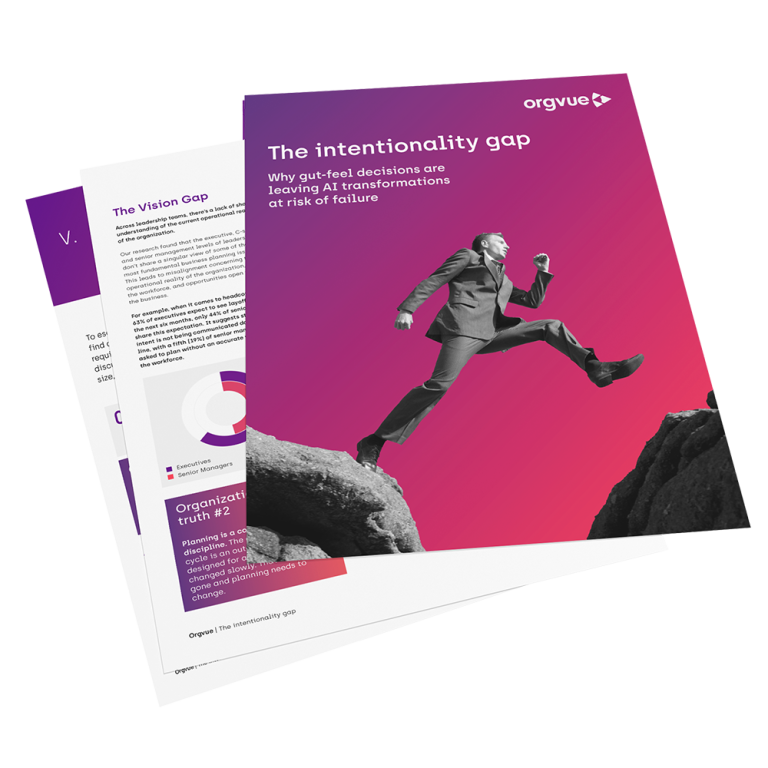
This is an intention gap: without shared reality and accountable follow through, cost decisions become reactive and the business case erodes in execution. Decisions get delayed, trade-offs stay unclear, and savings programs risk costing more than they save.
Orgvue found that organizations pay an average of $1.27 for every $1 saved through workforce reduction once hidden costs are included, so confidence in outcomes depends on follow-through, not plans.
You ARE battling
Persistent issues
- True work cost is unclear
Limited visibility into the cost of work, duplication, and wasted effort means risk builds before Finance can act. - Spend not linked to value
Difficulty connecting labor spend to strategy, productivity, and performance makes spend harder to defend and value harder to prove. - Scenario planning is too slow
Slow scenario planning limits the ability to test options, so capital gets committed before the real impact is clear.
- Trade-offs lack decision support
Unclear cost versus capability trade-offs during restructuring or investment decisions can deliver savings while harming delivery and growth. - No shared fact base
No shared fact base across Finance, HR, IT, and operations stalls decisions, slows transformation, and increases the risk of missing targets.
and now need to
Adapt to the impact of AI
AI is increasing pressure on Finance, but the bigger challenge is broader workforce and operating model change.
Finance leaders must raise productivity, guide investment, and control cost while work, roles, and capacity shift across the business. Static planning and isolated cost action make that harder and increase execution risk.
When Finance cannot test how workforce, structure, and AI related decisions will affect performance before committing, savings are harder to realize, capability gaps grow, and delivery suffers.
use ORGUVE to
Transform with intent
Orgvue gives Finance one governed system to connect workforce, cost, work, and organisational data.
With Orgvue, Finance leaders can test scenarios and quantify trade-offs before they commit, so they can judge where cost can be cut, which capabilities to protect, and how role design, spans, layers, and workforce mix will affect productivity and execution.
Leadership teams can then work from the same facts, compare future options, and turn financial strategy into workforce and organizational decisions that hold up in execution. The result is better capital allocation, faster decisions, and more confidence in outcomes.

For the CFO
- Protect the business case behind cost reduction decisions
- Show clearer progress against transformation and financial targets
- Tell a clearer story about cost, capability, and change
For finance leaders
- Connect labour spend to strategy, productivity, and transformation outcomes
- Move from reactive cost action to more intentional planning
- Make faster decisions with greater confidence
For financial planning & analysis
- Create a single view of workforce cost, headcount, and drivers
- Model scenarios fast to test savings, growth, and productivity trade-offs
- Track forecast vs actual workforce changes, explaining variance clearly
stop being reactive
How it works
See today clearly, compare future options, and lead change with intention

Connect workforce, cost and operations data
Bring together HR, finance, and operational data into one trusted, schemaless data foundation.

Understand work, roles and capability
See how work is distributed, where capacity and capability risks sit, where there is opportunity to leverage AI, and where structure is increasing cost or slowing decisions.

Model future scenarios with flexibility
Compare structure, sourcing, automation, and workforce options with a clearer view of cost, capability, service impact, and execution risk.

Turn decisions into action plans
Translate approved scenarios into practical changes across teams, roles, sourcing, and capability building.

Track outcomes and stay aligned
Monitor workforce and cost outcomes against approved decisions, with clear ownership, auditability, accountability and executive‑ready reporting.
Answer questions such as:
- Which roles, activities, and cost lines are most likely to be affected by AI and automation, and when will that impact show up?
- How much workforce capacity could be released over the next 2-3 years, and what is the most realistic path to capture the value?
- What is the credible return in workforce cost, productivity, and operating margin from each scenario?
- Where should we redesign work, and where can we redeploy people instead of adding cost or losing critical capability?
- How should we sequence automation investment across near, medium, and long term horizons?
- How will changes to work and productivity affect our workforce cost base, spans, layers, and operating model?
- What are the financial risks if redeployment, reskilling, or adoption moves more slowly than planned?
- Where are we carrying duplicate work, excess cost, or stranded capacity today?
- What new skills and roles will we need to support AI adoption without increasing structural inefficiency?
- How do we build an evidence based workforce plan that gives executives and the board confidence in the trade offs, timing, and financial impact?
Customer story
Delivering a successful 2-year transformation with multi-million dollar cost savings

$58M
Cost savings identified
$50m cost savings identified at the beginning of the transformation
281
Positions closed
Positions closed in the first 3 months of implementation, on track with cost savings target.
$6.4m
Unplanned positions added in Q1
Unplanned positions added in Q1, uncovered in the tracking process.

We had planned transformations before, but we never managed to track and stick to our plan the way we did with Orgvue.
CFO
Business goal
- Reshape the organization while still hitting cost saving goals
- Get HR and Finance aligned on one shared two year transformation plan
- Keep a clear way to track progress over time, not just design the plan once
Solution
- Trained 75 people across HR and Finance and connected data from their existing systems
- Used Finance targets to guide HR’s future state design, then produced a dated roadmap showing role changes and cost impact
- Set up quarterly tracking to compare the original plan with actuals, which helped confirm $58M in savings and uncover $6.4M in unplanned headcount in Q1
FAQs
Orgvue gives CFOs one trusted view of cost, work, structure, and capability. That makes it easier to see current reality clearly, understand trade-offs, and compare future options before committing.
It helps Finance leverage stronger evidence to planning, transformation, and board decisions, while moving faster from analysis to action.Is Orgvue built for executive decision making?
Orgvue helps Finance understand how AI changes work, roles, skills, and capacity, and ensures those decisions are risk managed, governed and tracked over time.
Yes. Orgvue is built for executive decision making across workforce, cost, structure, and transformation. It brings HR, finance, operations, technology, and transformation leaders together around the same decisions, with one view of the organization and a clearer way to reduce risk and turn decisions into action.
Yes. Orgvue helps compare workforce mix, assess cost versus capability trade‑offs, and understand service impact before decisions are made.
Reporting tools show what has happened. Orgvue helps leaders decide what should happen next by combining governed data, scenario modeling, and decision‑ready reporting.
Yes. Orgvue helps Finance identify structural inefficiencies, assess cost versus capability trade-offs, and model the impact of different options before action is taken.
See how Orgvue works
We’re excited to show you how Orgvue can help. Before we do, we’ll just need to schedule a quick call to better understand your needs and tailor a demo specific to you.
Complete the form to get started.
Not ready to book a demo?
Submit an enquiry
See our privacy notice. You can unsubscribe from marketing at any time by writing to us at [email protected].
Trusted by global enterprises