Orgvue for HR
Make future workforce decisions that hold up in execution.
Trusted by global enterprises









orgvue understands
The challenge for HR leaders
HR leaders are expected to guide the boardroom on how workforce choices affect cost, capability, and execution, turning people strategy into decisions that shape performance.
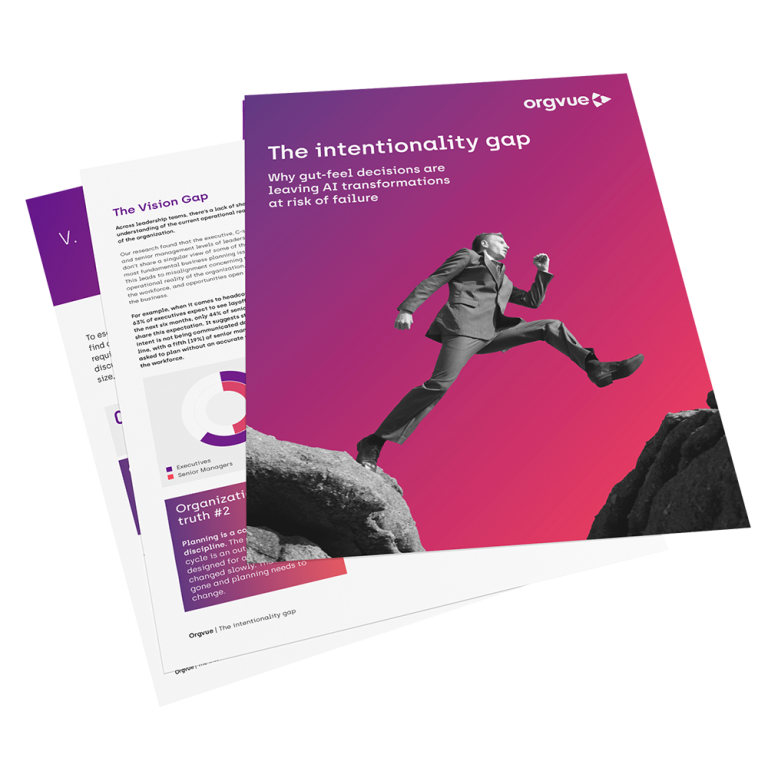
This is hard when workforce, work, skills, structure, and cost data sit in silos. The gap shows up when you are asked to hit targets without clarity on what work is changing or how decisions will land in delivery. Orgvue found 32% of organizations that made AI driven redundancies later had to rehire. With one governed workforce view, you can align structure to strategy and turn intent into execution.
YOU ARE battling
Persistent issues
- Visibility gaps hide capability risk
Limited visibility into work, skills, capacity, and structural risk means HR cannot see where capability is at risk until delivery starts to slip. - Plans not tied to priorities
Difficulty connecting workforce plans to business priorities and operating model change makes talent decisions harder to defend and harder to turn into outcomes. - Slow scenarios increase commitment risk
Slow scenario planning limits the ability to test options, so leaders commit before they understand the impact on capability, cost, and execution.
- Damaging trade-offs
Unclear trade-offs between cost reduction, redeployment, and capability building can deliver savings while damaging critical skills, retention, and future readiness. - No shared fact base
No shared fact base across HR, Finance, IT, and Operations stalls decisions, blurs ownership, and reduces transformation momentum.
ANd now need to
Adapt to the impact of AI
AI is reshaping work, roles, skills, and capacity across the organization. HR needs to shift the conversation from AI cost cutting to productivity, and from layoffs to redesigning roles so leaders can execute.
As change accelerates, the wrong cut or redesign can weaken delivery. Linking work to automation and augmentation potential helps you prioritize AI investment, reduce cost, and lift productivity. It positions you as the strategic partner who leads workforce decisions with the executive team.
use ORGUVE to
Transform with intent
Orgvue gives HR leaders one governed system to connect workforce, skills, cost, work, and organizational data.
That helps HR leaders decide where capacity should move, which capabilities to protect, and how role design, spans, layers, and workforce mix will affect performance, cost, and execution before they commit.
Leadership teams can then work from the same facts, compare future options, and turn workforce strategy into organizational decisions that hold up in execution. The result is faster alignment, stronger follow through, clearer accountability, and more confidence that transformation will deliver.

For the CHRO
- Guide the boardroom on how workforce choices affect cost, capability, and execution
- Lead workforce transformation with more control and less guesswork
- Turn people strategy into decisions that shape business performance
For HRBPs
- Support leaders with a clearer view of workforce risk and opportunity
- Improve decisions on teams, roles, and structure
- Strengthen alignment between workforce plans and business goals
For Organizational Design
- Build a single, trusted baseline for org and workforce decisions
- Model spans, layers and roles fast to test future-state options
- Turn design decisions into action with clear outputs and governance
stop being reactive
How it works
See today clearly, compare future options, and lead change with intention

Connect workforce, cost and operations data
Bring together HR, finance, and operational data into one trusted, schemaless data foundation.

Understand work, roles and capability
See how work is distributed, where capacity and capability risks sit, where there is opportunity to leverage AI, and where structure is increasing cost or slowing decisions.

Model future scenarios with flexibility
Compare structure, sourcing, automation, and workforce options with a clearer view of cost, capability, service impact, and execution risk.

Turn decisions into action plans
Translate approved scenarios into practical changes across teams, roles, sourcing, and capability building.

Track outcomes and stay aligned
Monitor workforce and cost outcomes against approved decisions, with clear ownership, auditability, accountability and executive-ready reporting.
Answer questions such as:
- Which roles and tasks are most likely to change with AI, and when should we plan for that impact?
- How much workforce capacity could be released over the next 2-3 years, and how do we turn that into real value through redeployment, reskilling, or smarter hiring?
- What is the credible return on AI and automation in workforce terms, including capacity, productivity, cost, and capability gains?
- How will AI reshape work, roles, spans, layers, and cross functional workflows across the organization?
- What new roles, skills, and career paths will we need as AI adoption grows?
- Where should we redesign roles, and where can we redeploy people with confidence?
- How should we sequence workforce change across near, medium, and long term horizons?
- How will our organization structure need to evolve as work changes and automation increases?
- Where are the biggest risks to capacity, capability, and employee trust if redeployment or reskilling falls behind?
- How do we build a transparent, evidence based workforce plan that gives executives confidence and helps HR lead change well?
Customer story
Danone adopts continuous approach to organizational development

50%
Reduction in time to model
Danone unlocked the ability to model their workforce in half the time.
30
Data sources integrated
Built out integrated dataset from 30 sources across 16 regions, 11 functional units and 3 business units
171
Leaders enabled
HR Directors and Business Partners trained in monitoring progress of new designs

Our aspiration is for Danone to end its company-wide transformation approach. We believe that by instead taking an ‘always-on’ approach, we can minimize disruption to the business, better react to changing organizational demands and, most importantly, better support our workforce.
Vincent Favre, Global Organizational Development Director, Danone
Business goal
- Shorten planning cycles from annual to quarterly reviews, to adapt to rapidly changing circumstances.
- Enable continuous tracking of workforce demand and supply. To enable better planning control, risk management and responsiveness to changing talent pools.
- Build a centre of excellence for org design with data at its core, and enable internal practitioners to model the org’s future-state.
Solution
- Migrated the position dataset from a previous transformation project into Orgvue, and set up the platform to link employees to positions and get an up-to-date picture of the workforce.
- Merged data from 30 different sources across 16 geographic regions, 11 functional units and 3 business units to produce a single, integrated dataset that created a centralized view of the entire organization.
- Built out an in-house organizational design capability, so practitioners can model the organization’s future-state design for themselves.
- Trained 67 organizational development practitioners in how to conduct data-driven organization design using Orgvue, and 171 HR directors and business partners in monitoring progress of newly deployed designs.
Ready to see Orgvue in action?
In a personalized demo session, discover how Orgvue can help you:
- Understand workforce impacts before restructuring
- Compare multiple operating model scenarios
- Find critical skill gaps across the organization
- Align workforce plans to business strategy
- Accelerate AI workforce transformation
Trusted by global enterprises
“Orgvue’s automated role-clustering capability will save a huge amount of time in surfacing opportunities for organizational redesign, workforce planning, and cost reduction. What we’ve seen so far is truly game changing for design work.”
Stacy Anderson, Salesforce
Get your personalized demo
30-minute discovery call
Demo tailored to you
See our privacy notice. You can unsubscribe from marketing at any time by writing to us at [email protected].
Not ready for a demo? Explore more…




FAQ: Orgvue for HR
Orgvue gives HR leaders one governed view of workforce, skills, cost, and structure. This makes it easier to compare options, align leaders, and guide decisions that stand up in execution.
Orgvue is built for executive decision making across HR, Finance, IT, and Operations. It brings leaders together around the same workforce decisions, so they can align faster, act with more confidence, and track outcomes over time.
Orgvue helps HR understand how AI changes work, roles, skills, and capacity, and ensures those decisions are governed and tracked over time. It links AI adoption to the work to be done, so you can deliver measurable productivity gains while improving financial outcomes.
Yes. Orgvue helps HR assess organization design, model workforce change, and compare trade-offs before action is taken.
Reporting tools show what has happened. Orgvue helps leaders decide what should happen next by combining governed data, scenario modeling, and decision-ready reporting.