Job architecture explained: Roles, skills, and levels
Job architecture is the structured framework that defines roles, job families, levels, and skills across an organization. It gives leaders a clearer view of how work is organized, reduces title and leveling sprawl, and creates a stronger foundation for workforce planning, internal mobility, and skills-based transformation.
Economic pressure is forcing harder choices. AI is reshaping work. And in large organizations, complexity continues to grow across roles, skills, reporting lines, and workforce plans.
Leaders need to redesign work faster, but they often can’t clearly see which jobs exist, how similar roles compare, or where critical skills sit today.
Job architecture brings structure to that complexity. It creates the framework behind role clarity, skills visibility, and better workforce decisions. Organizations get a clearer view of how work is structured and a stronger basis for workforce transformation at scale.
This guide explores what job architecture is, why it matters, and how to build an approach that brings more consistency, confidence, and control to workforce design.
What is job architecture?
Job architecture is the framework that defines and organizes roles across an organization. Think of it as a blueprint for how work is structured. Job architecture groups jobs into families, defines roles, sets levels, and identifies the skills and capabilities that matter in each area.
In most large organizations, work is not as neatly organized as it looks on paper:
- Job titles change in inconsistent ways over time.
- Similar roles are often assigned different levels across teams or regions.
- Workforce data often reflects years of change, restructuring, and local decision-making.
Job architecture solves these problems. It turns scattered data into a more consistent view. Leaders can compare roles more accurately, support fairer pay, and provide better career paths.
In other words, job architecture connects strategy to structure by showing how roles, levels, and skills fit together at scale.
Why job architecture matters
Without job architecture, basic workforce decisions get harder than they should be. Leaders struggle to compare similar roles, define fair progression, support internal moves, and see where skills gaps are starting to slow the business down.
A clear job architecture helps by creating a consistent structure for roles, levels, and skills. That makes it easier to:
- Improve transparency: Clarifies how roles relate across teams, business units, and geographies.
- Support career path clarity: Makes progression easier to understand and apply consistently.
- Strengthen pay equity: Makes it easier to compare like-for-like work across the organization.
- Enable internal mobility: Reveals where roles overlap and where adjacent moves are possible.
- Build skills intelligence: Links roles to capabilities, making skill gaps easier to identify earlier.
- Increase organizational agility: Creates a stronger foundation for workforce planning and redesign.
Job architecture provides the greatest value in a broader strategic workforce planning framework where roles, levels, and skills are clearly connected.
Core components of a job architecture framework
A job architecture framework creates a consistent way to define work across the organization. While every business shapes it differently, most rely on the same core components.
Job families
Job families group related work into broad categories such as finance, sales, engineering, HR, and operations. These categories create the first layer of consistency. Instead of treating each title in isolation, organizations can organize work to reflect how the business actually operates.
Roles
Roles sit within job families and define distinct types of work. They make job architecture actionable by allowing organizations to group similar positions into defined roles.
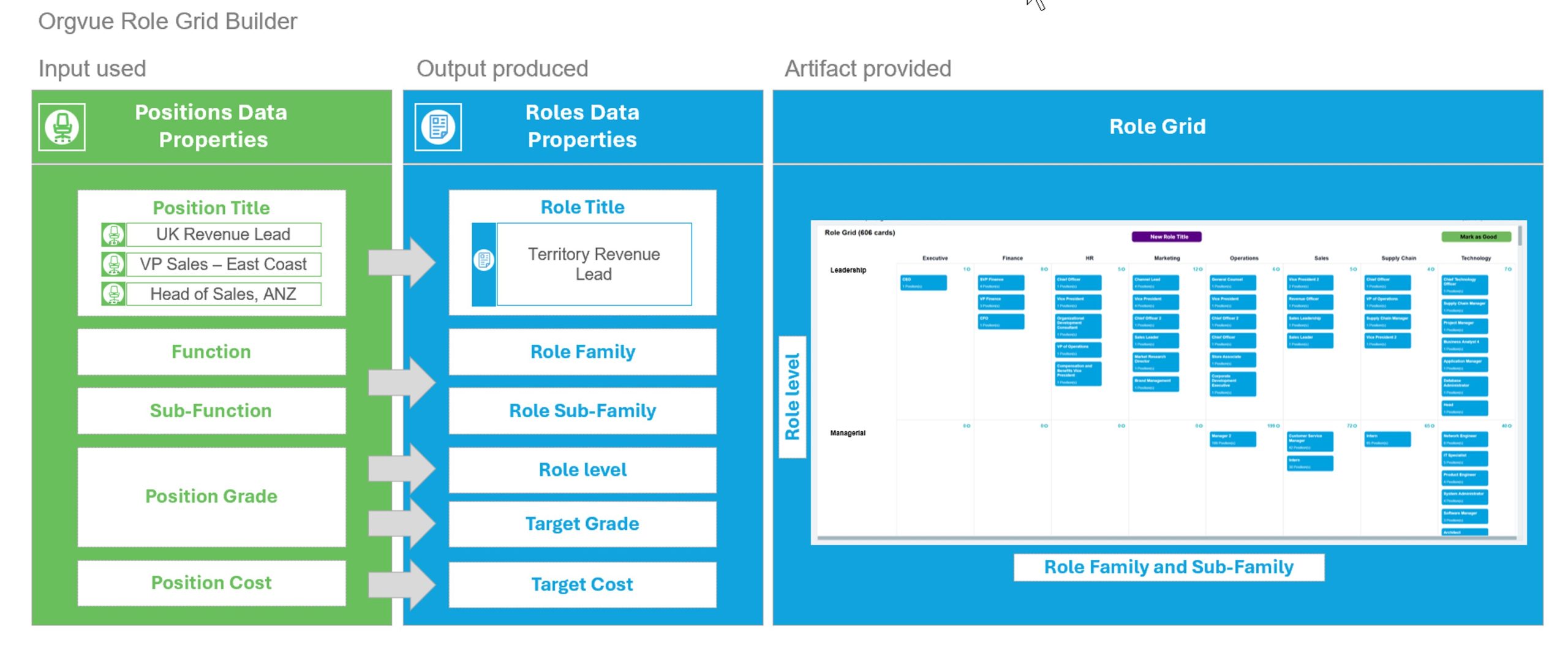
That grouping is the foundation of a role grid — central to several organizational design types. The role grid gives leaders a clearer view of:
- Where work aligns.
- Where duplication exists.
- Where roles can be standardized or refined.
It becomes the central reference point for organizing work consistently across the business.
Levels
Levels define progression within a role or job family. They create shared criteria for role complexity, accountability, and decision-making.
A strong level structure shows how expectations change from one level to the next. With this information, organizations can:
- Support fairer pay.
- Enable clearer progression.
- Drive more consistent workforce planning.
Skills and capabilities
Skills and capabilities show what each role requires now and how it may need to evolve. Here, job architecture supports more than structural clarity.
By connecting roles and levels to skills, organizations:
- Strengthen internal mobility.
- Plan reskilling more effectively.
- Build a stronger foundation for workforce transformation.
Governance and data
Governance keeps the architecture consistent over time. Data makes it possible to base decisions on how work is really structured today. In most organizations, the raw information already exists across HR systems, job catalogs, and workforce records. The challenge is that it is often inconsistent, spread across systems, or hard to use.
Governance helps maintain standards, and better data helps leaders keep the framework aligned to the business as roles, skills, and structures change.
Common challenges in building job architecture
Building job architecture is rarely just a design exercise. The harder part is dealing with the inconsistencies and local variations that have built up across the business:
- Regional inconsistencies: It’s hard to compare roles cleanly from the start when countries, business units, and functions treat similar work differently.
- Leveling issues: Level definitions may seem clear at first, but they often become inconsistent when applied across different parts of the organization.
- Data quality problems: Duplicate roles, outdated job descriptions, incomplete records, and local naming conventions make it hard to clearly see how work is organized.
- Static architecture risk: The architecture needs regular review to keep up with shifting roles, skills, and business priorities.
Effective job architecture needs more than a strong design. It needs governance, clean workforce data, and a process for keeping the structure aligned as the organization changes.
How to build a job architecture
There is no single template that fits every organization. But the strongest approaches usually follow the same sequence: clean the data, define the structure, set level criteria, connect roles to skills, and put governance in place.
Audit and clean the positions data
Start with a reliable view of the organization as it exists today. Analyze the roles, titles, reporting lines, and workforce records already in place.
This step usually reveals how much inconsistency has built up over time:
- Duplicate titles.
- Different level labels for equivalent roles.
- Legacy records that no longer reflect how the business operates.
Cleaning that data makes later stages of building a job architecture more reliable.
Design the role grid
Group positions into roles and role groups to build a clear, consistent view of how work is structured. It should reveal where roles cluster, where overlap exists, and where standardization makes sense.
The role grid should also connect job architecture to broader questions of organizational design and structure. Identify patterns across existing roles, and group them into a structure that reflects the work, not just legacy job titles.
Define levels and criteria
Once the role structure is in place, define how career progression works. That means setting level criteria that teams can apply consistently across functions:
- Scope.
- Complexity.
- Autonomy.
- Problem-solving.
- Accountability.
Strong criteria show how expectations change from one level to the next. They create a more consistent basis for pay decisions, career progression, and role comparisons.
Connect roles to skills
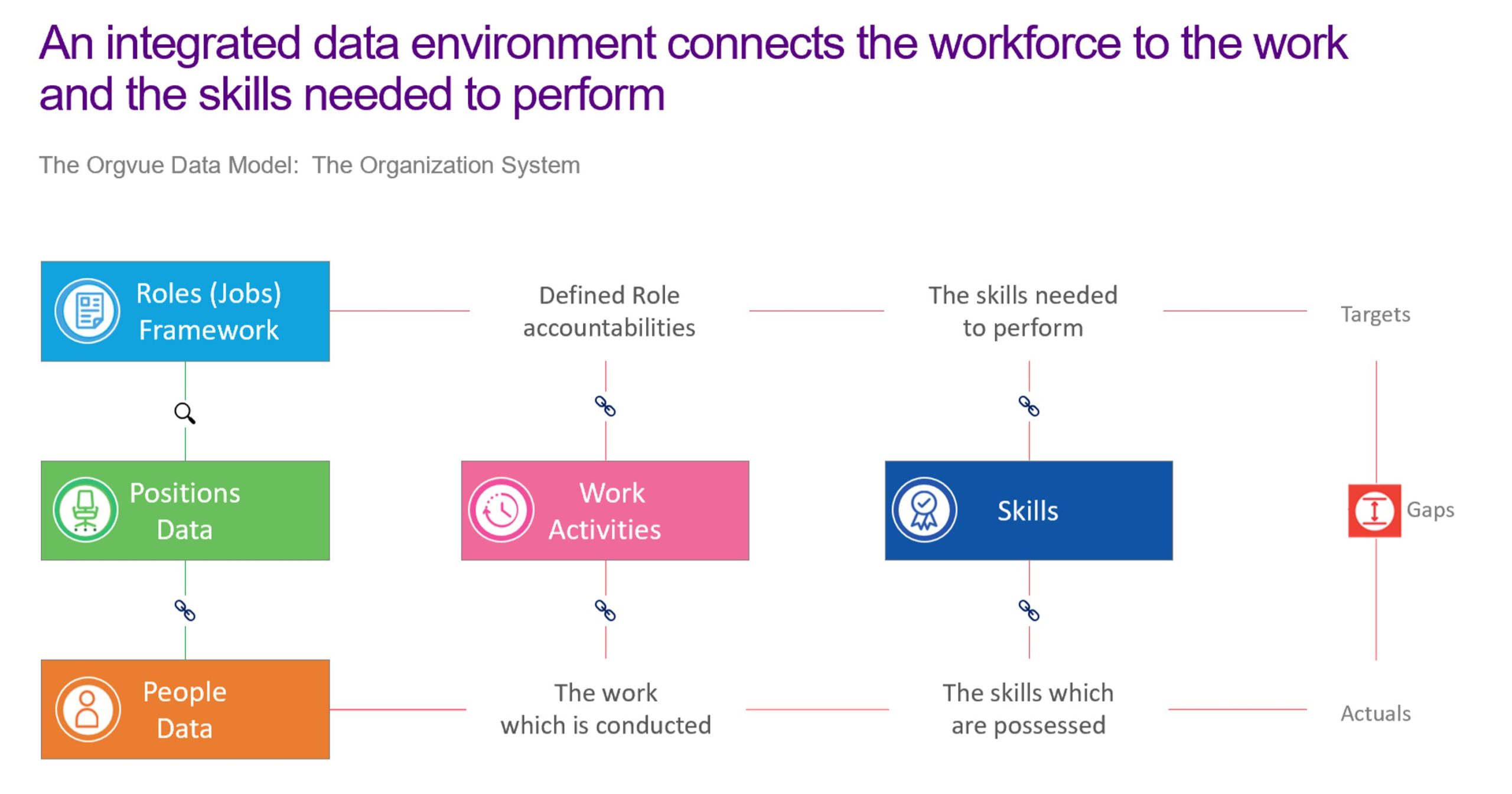
A modern job architecture should connect roles to the skills and capabilities required to do the work well. That link shows you:
- Where critical skills are concentrated.
- Where gaps are emerging.
- Where people can realistically move or reskill.
The architecture becomes more adaptable over time. The underlying capabilities often indicate where work is heading, even as roles change.
Operationalize and maintain
Make the architecture usable by embedding it in workforce planning, talent processes, organizational design, and governance routines.
Clear ownership is essential here. Someone needs to:
- Maintain standards.
- Review new roles.
- Manage exceptions.
- Revisit assumptions as the organization changes.
Otherwise, job architecture drifts back into inconsistency.
Job architecture and skills intelligence
Roles, levels, and job families define how work is organized. But skills intelligence shows which capabilities are needed, where they exist, and how they are changing.
That visibility expands job architecture into a clear view of workforce capability that supports:
- Workforce planning: Looks beyond headcount to show whether the right skills sit in the right places, where shortages may slow execution, and where reskilling can reduce risk.
- Internal mobility: Reveals realistic career paths by showing skill overlaps and possible adjacent moves, instead of relying on title-based progression.
- Reskilling: Shows how capabilities need to develop as work changes, so organizations can prepare people for new role demands earlier.
- AI-driven analysis: Uses AI to cluster similar roles, identify patterns in workforce data, and surface skill relationships that are difficult to see at enterprise scale.
With skills intelligence, job architecture connects work, skills, and change into a single view. It supports broader workforce transformation by making capabilities clear and easy to plan around with greater confidence.
Job architecture examples in practice
Large organizations struggle with role clarity when similar work is labeled differently across markets, progression relies on tenure or title history, and job catalogs don’t align after mergers or acquisitions (M&A). These challenges become most visible when workforce decisions need to move quickly, stay consistent, and support change at scale.
Job architecture brings more consistency, clarity, and control to complex workforce decisions by:
- Standardizing titles across regions: Defines consistent roles beneath local variations, clarifying pay comparisons, workforce reporting, and career pathing.
- Skills-based leveling: Defines progression through the complexity of work, scope of responsibility, and capabilities required at each level. That creates a clear, defensible structure.
- M&A integration: Helps leaders compare roles, reduce overlap, and create a shared structure for the combined workforce.
For a deeper look at how leaders are approaching this in practice, watch our job architecture webinar.
Making job architecture a living framework
In large enterprises, job architecture delivers the most value when it’s reviewed regularly and updated as the business changes — through:
- Annual reviews.
- Post-structure refreshes.
- Targeted updates driven by strategy shifts, emerging capabilities, or how AI changes work.
In practice, that means checking whether:
- Role definitions still reflect the work being done.
- Level criteria still hold up across business units.
- Skills links still match changing capability needs.
AI can surface patterns, inconsistencies, and role changes faster than manual review alone. But the goal is still the same: keep the framework aligned to the business, so it stays current, credible, and useful over time.
Accelerating job architecture with AI and modeling
Building and maintaining job architecture manually is time-consuming and hard to scale across global enterprises. It becomes even more difficult when workforce data is fragmented across systems, titles have multiplied over time, and local variations make clean comparisons difficult.
AI speeds up existing workforce analysis
AI gives leaders a faster way to move from large workforce datasets to clear role structures by:
- Clustering similar roles.
- Surfacing inconsistencies.
- Highlighting opportunities to consolidate or refine the architecture.
The role grid stays central. It organizes work into a clear model, while AI reveals patterns that are difficult to spot at scale.
Modeling informs workforce changes
Once the architecture is in place, organizations can test how changes to roles, levels, or skill needs affect the wider workforce before making large-scale decisions.
Orgvue adds value here by consolidating workforce data into a single view, clarifying the current structure, and modeling what may need to change next. That makes job architecture easier to scale and adapt.
Building the foundation for workforce transformation
Job architecture gives organizations a clearer way to understand work, define roles, connect skills, and plan for change. That matters even more when the business is under pressure to redesign work faster, improve resilience, and make workforce decisions on better evidence.
Done well, job architecture becomes a foundational capability. It supports data-driven design, future readiness, and more confident transformation decisions across the enterprise.For organizations looking to strengthen that foundation, explore Orgvue’s job architecture solutions. And if you want to see how a more connected view of roles, skills, and structure can support your workforce strategy, get a demo.
FAQ: Job architecture
A job architecture framework is the structured model used to organize work across an organization. It typically includes job families, roles, levels, skills, and governance rules, enabling leaders to bring consistency to workforce data, role design, and career progression.
Job grading focuses mainly on evaluating roles for size, value, or pay alignment. Job architecture is broader. It defines how work is organized across roles, levels, and families, and creates the structure that supports grading, mobility, workforce planning, and skills visibility.
Most organizations should review job architecture at least annually. It should also be revisited after restructurings, acquisitions, major strategic shifts, or significant changes in the demand for work and skills.
Yes. Job architecture helps skills-based organizations by providing the structural layer beneath skills data. When roles, levels, and skills are connected, leaders can better support mobility, reskilling, capability planning, and a more flexible view of how work gets done.
Most organizations begin with workforce data, job titles, reporting structures, job descriptions, workforce records, and existing level structures. Skills data can also strengthen the approach further.
Job architecture
Use Orgvue to streamline your workforce design.
Table of contents
- What is job architecture?
- Why job architecture matters
- Core components of a job architecture framework
- Common challenges in building job architecture
- How to build a job architecture
- Job architecture and skills intelligence
- Job architecture examples in practice
- Making job architecture a living framework
- Accelerating job architecture with AI and modeling
- Building the foundation for workforce transformation
- FAQ: Job architecture
Related posts
 Webinar/Event
Job architecture: Building the foundation for organization design and workforce planning
Webinar/Event
Job architecture: Building the foundation for organization design and workforce planning
 Article
Organizational design vs structure: A comprehensive analysis
Article
Organizational design vs structure: A comprehensive analysis
 Podcast
Headcount vs. Workforce Planning: What you need to know, with Badr Ait Ahmed
Podcast
Headcount vs. Workforce Planning: What you need to know, with Badr Ait Ahmed
