Organizational design
Building human led, AI enabled organizations with intent
Building an organization that can adapt
Most organizations redesign only when pressure hits. Intentional enterprises treat organization design as a continuous capability, using data to see what is changing and why, before decisions become urgent. Structures cannot stay static. Shifting markets and expectations create pressure long before it is visible. A redesign that takes six months every few years cannot keep pace. You need clarity that lets you adapt by design rather than necessity.
Organizational design connects strategy to structure. It brings together systems, roles, skills, performance, culture, and processes to create an organization that can move with intent.
Want to know more?
How mature is your organizational design?
The realities of organization design
Designing any organization means managing constant movement. Each change affects how people work, how value flows, and how strategy gets delivered. This creates recurring challenges:
- People and politics can focus design individuals rather than business needs.
- Fragmented data makes it hard to see where risks, gaps, or opportunities lie
- Design process is often mistaken for Org charts when true design needs principles, organizational system thinking, and testing options before change reaches people

Organizational design is driven by the business strategy and operating context, and requires holistic thinking around systems, structures, people, performance measures, processes, culture, and skills.
Naomi Stanford, Organization Design Consultant
How Orgvue helps
Whether you are responding to immediate pressure or building long term capability, Orgvue gives you the intelligence to see impact before you decide and to model transformation before you commit.
With Orgvue, you can analyze, design, plan, and monitor your organization in one platform so you can:

See your organization clearly
Bring together data from across the business and reveal how work, roles, and performance connect. Spot risks, gaps, and inefficiencies that are otherwise hidden.

Model scenarios quickly
Use interactive visuals and AI enabled insights to explore options grounded in evidence. Understand how changes to structure, skills, cost, or location will affect your organization.

Engage stakeholders with confidence
Share clear, compelling visuals that explain not just what is changing but why. Build alignment earlier and reduce uncertainty.

Track change over time
Monitor progress against your design principles. Identify where plans are drifting, where capacity is strained, or where new opportunities are emerging.
Seeing the organization as a connected system
Successful design starts with understanding your organization as a living system rather than a static structure. People, roles, and work are constantly shifting and depend on the wider ecosystem in which the organization operates. To manage this complexity, you need to see how work flows, where activities combine to create value, and how changes in one area affect performance elsewhere.
Orgvue visualizes these relationships so you can understand workforce demand, compare it with supply, and adjust the flow of work as circumstances change.
The objective of organization design is to ensure organizations have the right people, with the right skills, doing the right work in the right way in the right numbers with real alignment to achieve strategic objectives.
Rupert Morrison, Data Driven Organizational Design
Henshaw Assistant

Ask, and your data answers
Henshaw Assistant brings your data to life, giving you instant clarity on your workforce.
Ask questions like:
- Which departments have an average span of control below my target of 6?
- In which departments are their “Data analyst” positions?
features and benefits
How Orgvue supports organization design
See how your organization really works
- Clean and organize messy data to reveal how work, roles, and performance move over time
- Spot where capacity is constrained, where skills are mismatched, and where management changes may affect results
- Gain clear, actionable insight to make intentional decisions grounded in evidence
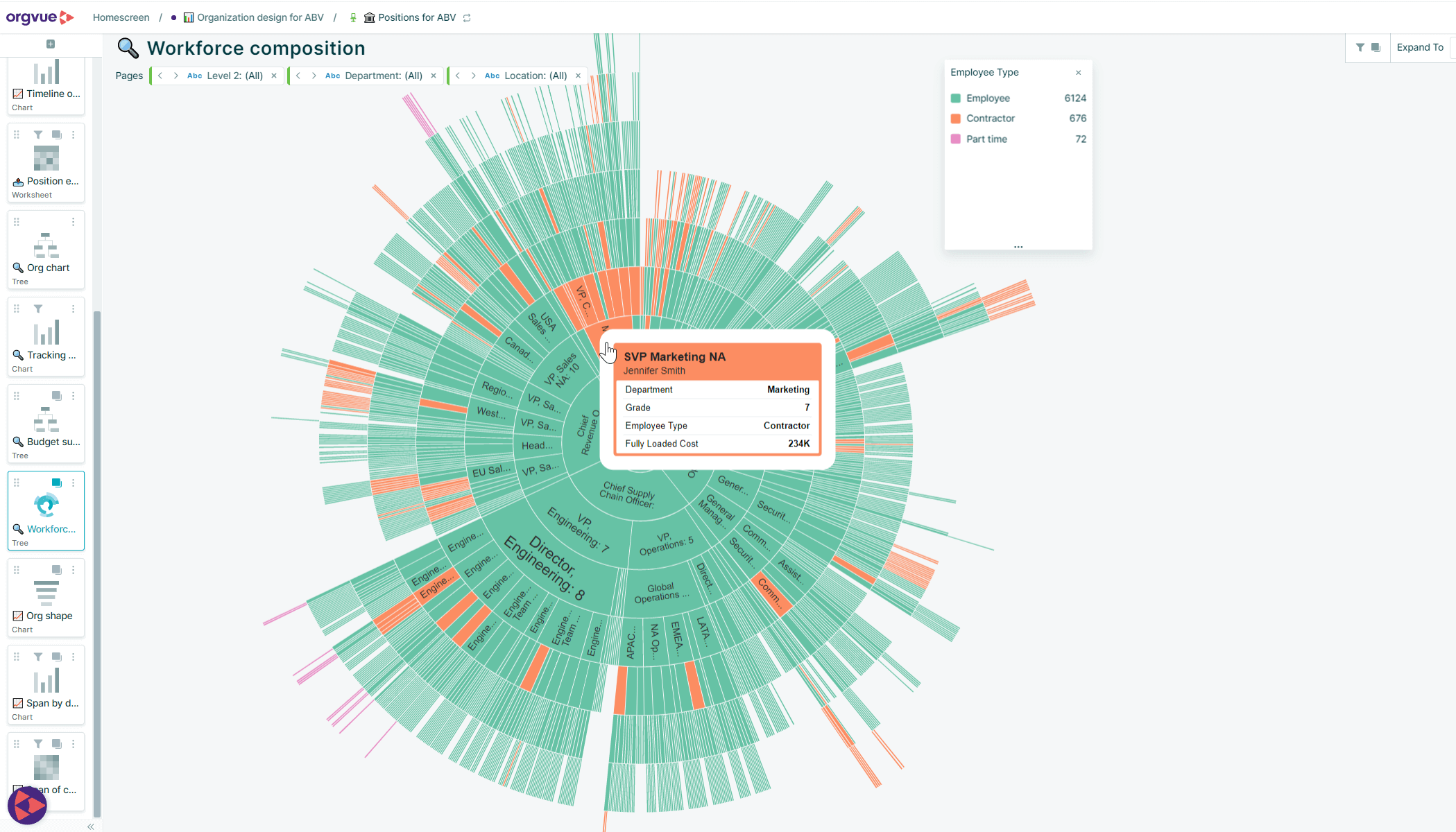
Screenshot from Orgvue platform of a sunburst graphic illustrating an organization broken down by employee type
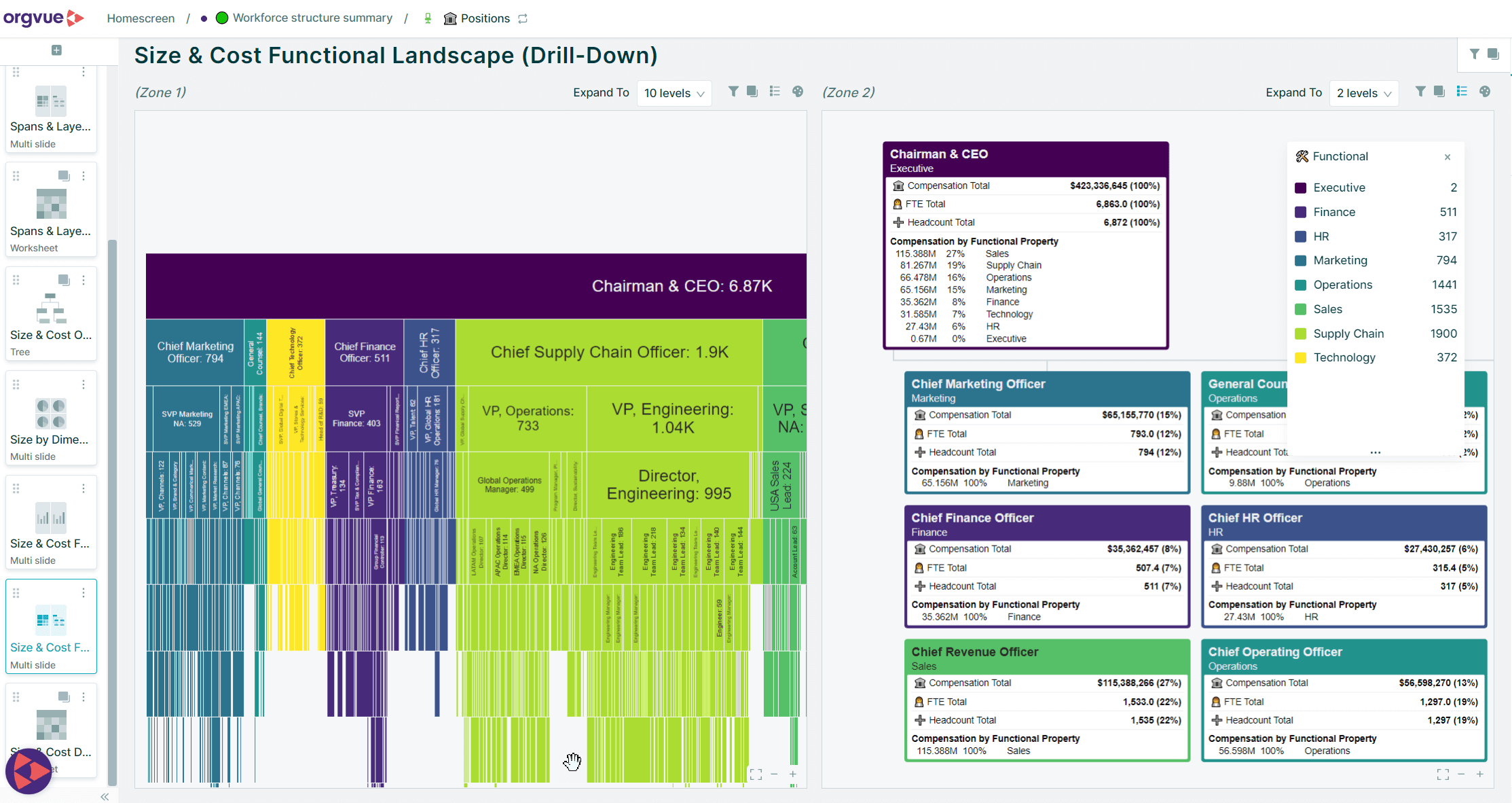
Using Orgvue to visualize the different departments
Using Orgvue to understand and analyze activities across the organization
Build a single view of your business
- Bring together data from across HR and the business to create one shared source of truth
- Use Henshaw AI to organize thousands of positions into a structured role architecture
- Apply solution packs to surface insights from high level trends to detailed patterns
- Colour code by location, grade, skills, or cost to highlight what matters
- Export visuals to share clear, aligned stories with stakeholders
Explore organizational health
- Use pre built visuals to examine key dimensions such as spans and layers, age and tenure mix, vacancies, skills supply, and representation
- Understand the impact of AI on roles, workloads, and the design principles shaping your organization
- Answer essential design questions including how many layers you have, where grades sit, and whether capacity is distributed as intended
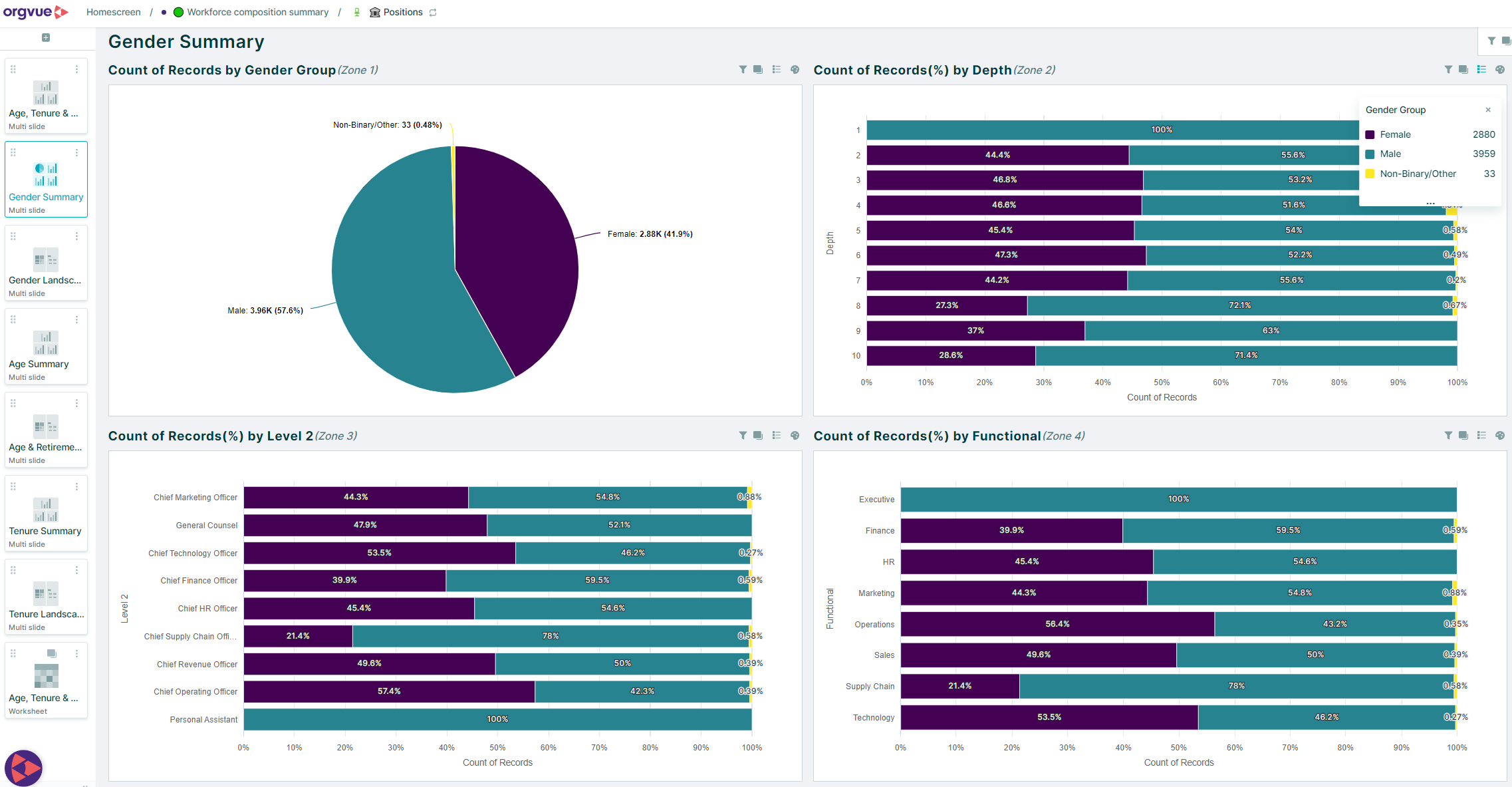
Orgvue graph showing the breakdown of diversity and inclusion on the platform
Easily model your future organization in Orgvue
Model future scenarios before you commit
- Drag and drop teams or roles to test structural, financial, and operational scenarios in minutes
- Assess the impact of relocating teams, shifting to remote work, centralizing functions, or outsourcing roles
- Explore where investment in AI would have the greatest effect on performance and cost
See your future state clearly
- Visualize the whole organization to check alignment with strategic goals
- Identify areas that need deeper analysis before changes reach people
- Create a future design that is resilient, transparent, and ready to evolve
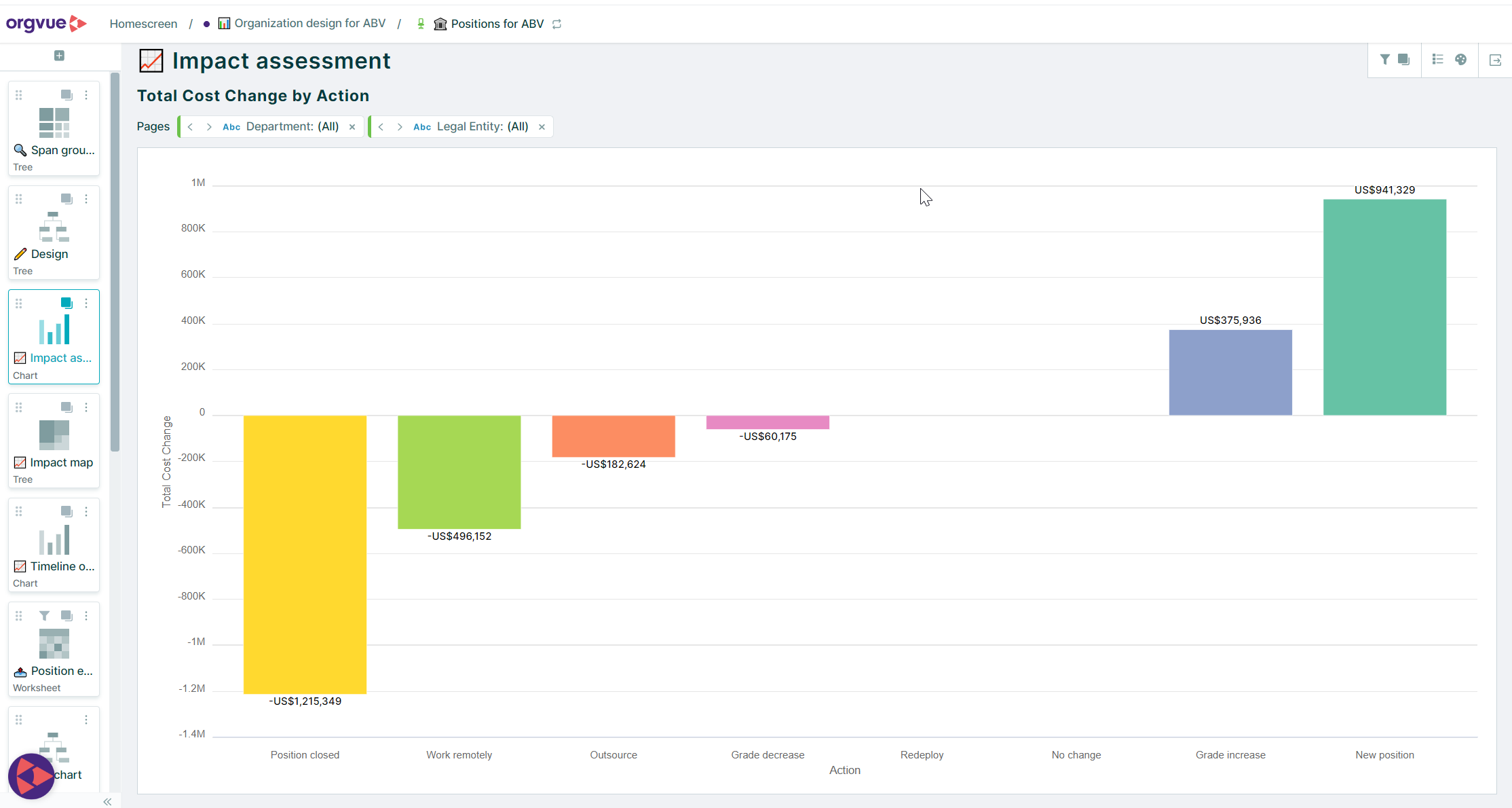
Screenshot of an Orgvue chart showing savings and expenditure by organizational changes
Organization design self assessment
In only one minute see your company’s capability compared with our industry benchmark in your free report with hints, tips, and recommended next steps.
FAQs
Organizational design is the discipline of shaping an organization to better achieve its business strategy and objectives by aligning its people and the skills they have with the work they do.
It involves designing how jobs, roles, and responsibilities are distributed throughout the organization. This includes building a structure that aligns with the mission, encourages collaboration, and unlocks adaptability. It is about creating a well organized, interconnected, and purpose driven environment that brings success and effectiveness to the forefront, in short creating an intentional enterprise.
Adapt: Research has shown that even the best business forecasters are unable to plan reliably more than 400 days out. Businesses must now find a way to adapt quickly to change, make fast decisions and plan continuously using accurate, consistent data.
Agile: Instead of working to a 3-year plan, organizations will need to become more agile in how they respond to uncertainty and change. They’ll need to get used to continuously adjusting their business plans in shorter and shorter cycles.
Advance: This is where organizational design takes on new importance. Until now, structuring an organization has assumed a certain predictability in market behavior. Today those assumptions have all but disappeared.
The time to fundamentally rethink organizational structure has come. Being able to design your organization and plan your workforce as an interconnected, cyclical process is where people are going and with Orgvue’s help, you can get there too.
As companies develop and grow, systems and processes become more complex and can fall out of alignment with business strategy. Consequently, those organizations that don’t continuously monitor business performance are likely to experience a number of problems:
– Dysfunctional workflows that stall or break down
– Siloed, fragmented workloads with low quality output
– Duplication or redundancy of activities
– Poor accountability for activities and delays in decision making
– Poor information and lack of authority to solve problems as they arise
– Lack of trust between managers and employees
These problems are all symptomatic of underlying causes related to organizational design.
Implementing organization design effectively requires a strategic and thoughtful approach, encompassing various stages and considerations. Ensuring you have the right technology which will allow you to see your data and manage it with confidence is a crucial aspect of this process, especially for large organizations. The steps of organization design include:
1. Bringing in your data and ensuring you can trust it
2. Assess and analyse your organization, see your current state and identify gaps
3. Design your to-be organization, making sure you can see the impact of your changes and revert back if needed
4. Implement your plan, and make sure you’ve allocated the right tasks to the right stakeholders
5. Track and monitor your plan, and course-correct where needed
Once you have an indication of the gap between supply and demand, you can begin breaking down roles into the processes and activities (in other words, the work), alongside the skills and competencies needed to do that work. Using accountability metrics, this allows you to measure how effectively the work is organized and distributed.
Your business is then in a position to monitor workforce productivity using associated data points to check that work isn’t being duplicated, trim back work where too much effort is being invested in particular activities, and redirect effort elsewhere when needed. Importantly, it also means the financial impact of any changes can be tracked.
This is far more insightful than tracking salary costs across the workforce, for example, which doesn’t tell you the financial contribution the workforce is making, only how much it’s costing you. By shifting focus to the work, you can quantify the value that your workforce delivers.
Designing an organization that’s more responsive and resilient to unforeseen changes calls for a more precise understanding of your organization as it is today. Design methodology considers activities (work), competencies (knowledge and skills), roles (to complete the work), and human capital (people with the right competencies) needed to fulfill positions and meet objectives (targets).
Broadly speaking, there are three steps to successful organizational design. You begin with the big picture, then go into the practical detail, and finally focus on putting the design into practice. Then it’s a case of continuously repeating that cycle by tracking and monitoring progress. Organizational design, like workforce planning, is a habit, not a one-time event:
Macro design
In Organization design, macro design refers to the higher-level, strategic considerations and decisions that shape the overall structure and framework of an organization.
High-level modeling
Micro design
This is all about the detail. You need to understand what roles you have, the rationale for those roles, and the activities that each role and position is responsible for.
Position-level monitoring
Design in practice
Going from micro design to implementation is an iterative process. You won’t get micro design entirely right the first time but that’s better than doing no micro design at all.
Successful organizational design recognises that organizations are connected systems, not static structures on paper. They are complex organisms with many moving parts that change and evolve based on their environment.
System visualization
Demonstrating that the effectiveness of organization systems is greater than their component parts isn’t difficult. What’s challenging to understand is exactly why this is. And to do that, you need to be able to visually represent those systems with data.
Orgvue uses a conceptual model to describe the relationship between people and work, so you can see how different activities combine to drive business performance. The model enables you to monitor and adjust the nature and flow of work in response to changing circumstances.
The organization as a system
This model is different from others in that it breaks down the organization system using data points to deconstruct people, roles, and positions, as well as enabling gap analysis aimed at optimizing the system.
You begin by associating individuals with positions, which are grouped by role. For example, you may have several sales managers (role) for different regions (positions). This relationship helps to quantify the workforce demand of the business over time, which can then be compared with the supply that the current workforce represents.







See how Orgvue works
We’re excited to show you how Orgvue can help. Before we do, we’ll just need to schedule a quick call to better understand your needs and tailor a demo specific to you.
Complete the form to get started.
Not ready to book a demo?
Submit an enquiry
See our privacy notice. You can unsubscribe from marketing at any time by writing to us at [email protected].
Trusted by
More resources

 Webinars & events
Job architecture: Building the foundation for organization design and workforce planning
Webinars & events
Job architecture: Building the foundation for organization design and workforce planning
 Articles
Organizational design vs structure: A comprehensive analysis
Articles
Organizational design vs structure: A comprehensive analysis
