The £5 billion layoff trap: What business insights reveal about FTSE 100 workforce dynamics
Orgvue’s analysis reveals that FTSE 100 companies spent £5 billion on layoffs in 2024 yet saw little workforce change.
The FTSE 100 accounts for 81% of the total value of all companies listed on the London Stock Exchange. But despite their financial clout and influence on the UK economy, these companies are caught in a costly cycle of workforce restructurings.
Our analysis of annual reports filed by FTSE 100 companies reveals severance costs totalling £5 billion in 2024 alone, yet the aggregate workforce changed very little.
Bottom-up analysis of company filings shows a costly and complex dynamic as companies struggle to balance the size and composition of their workforces in line with business performance.
Workforce stability: More illusion than reality
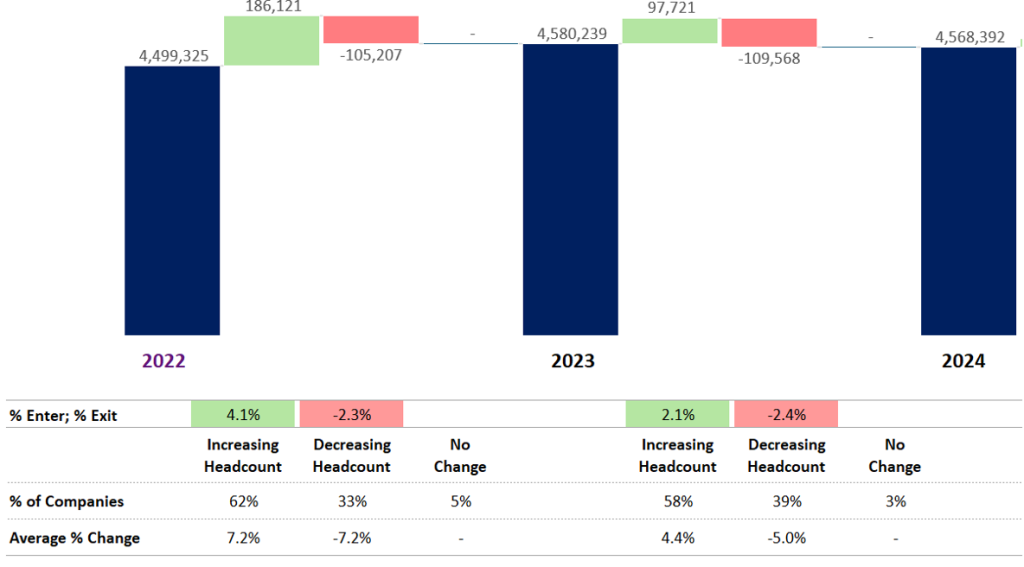
At first glance, employment appears to be stable. Between 2022 and 2024, the overall number of employees was relatively unchanged at around 4.5 million. But when you dig below the aggregate-level totals, a more turbulent reality emerges.
Most companies increased their workforces in 2024, but the proportion has edged down from 62% in 2023 to 58%. The scale of change has also fallen from an average increase of 7.2% in 2023 to 4.4% in 2024. By contrast, 39% of companies decreased their workforces in 2024 (up from 33%) on average by 5%.
The human workforce continues to fuel revenue growth
Our analysis brings into question the headline-grabbing announcements that proclaim AI as leading the workforce revolution, enabling companies to deliver ‘more with less’.
While it’s true that almost one in five FTSE companies did do more with less in 2024—increasing revenues while decreasing headcount—a much greater proportion (almost half) invested in human-fueled growth by increasing their workforces to deliver top-line performance gains.
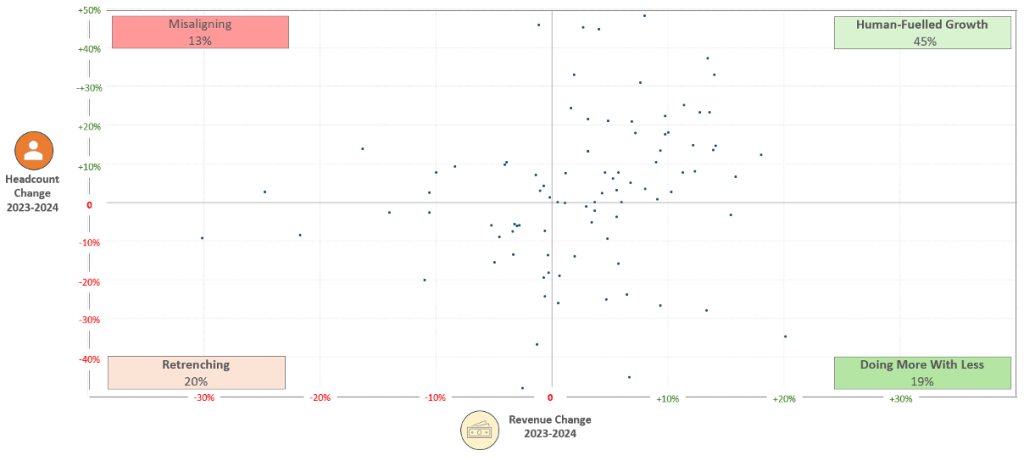
However, this observation doesn’t support the suggestion that AI-led workforce change is at play here. There are two kickers:
- Only 4% of companies did more with less over two consecutive years. The same proportion is observed across US Fortune 500 companies.
- Companies demonstrating human-fueled growth delivered more than two times the revenue growth of those doing more with less.
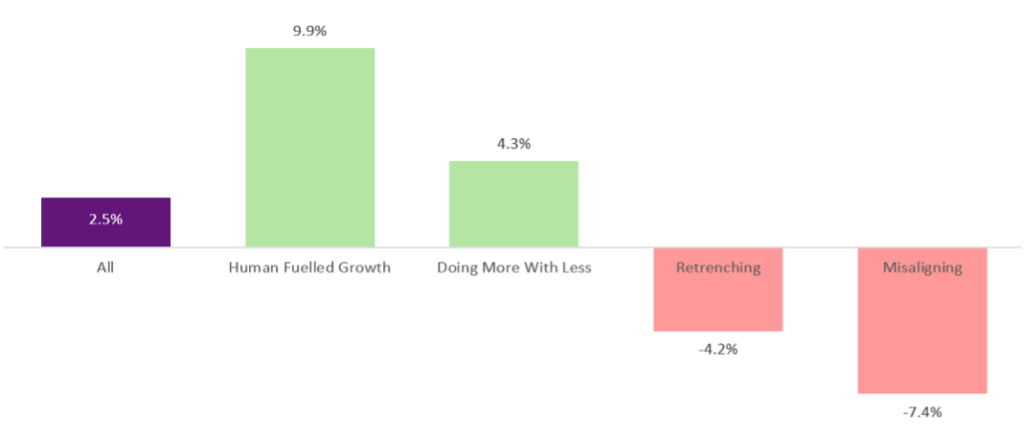
The disparity in performance between organizations that increase headcount and those that reduce it highlights the financial consequences of different workforce strategies.
After making workforce cuts, many companies struggle to get off the cost-out transformation treadmill. 55% of companies that reduced their workforce in 2023 followed up with further cuts in 2024. On average, these companies saw revenues decline by £296 million over two years.
Cutting back on human capital investments disproportionately impacts productivity, damages customer relationships, and weakens competitive advantage, creating a negative cycle that’s difficult to break.
The hidden truth behind workforce reductions
Our modeling of Bloomberg’s assumptions published in The True Cost of Layoffs reveals that for every dollar saved through redundancies, companies end up incurring $1.27 in severance costs, lost productivity, and higher employee attrition.
Despite the seductive appeal of repeating annual cost cuts, these typically erode post-transformation through insufficiently disciplined cost management. In the long run, short-term gain ends up costing more.
UK business leaders must reassess
Business leaders should reassess the true cost of their workforce reduction programs. Sustainable revenue growth comes from careful investment in people.
Companies that can forecast accurately, track workforce metrics consistently, and redeploy talent flexibly can avoid becoming trapped in a costly redundancy cycle and instead build a foundation for sustainable business performance.
Strategic workforce planning
Use Orgvue to streamline your organization.
More resources
 Article
The $40 billion secret: What workforce insights reveal about Fortune 500 companies
Article
The $40 billion secret: What workforce insights reveal about Fortune 500 companies
 Webinar/Event
Beyond fire and re-hire: building a sustainable workforce for the future
Webinar/Event
Beyond fire and re-hire: building a sustainable workforce for the future

 Article
“I’d rather quit”: Study shows how CEOs really feel about transformation projects
Article
“I’d rather quit”: Study shows how CEOs really feel about transformation projects